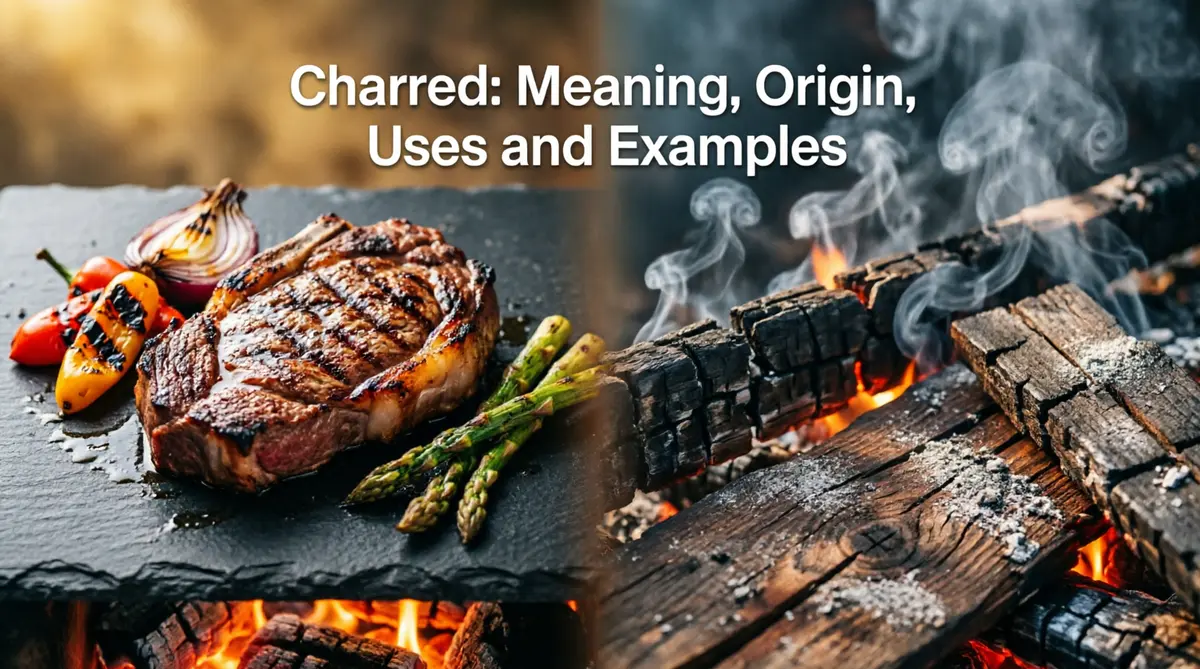
When someone describes a steak as perfectly charred, they are probably complimenting the chef. But if a news report mentions a charred building after a fire, the word paints a very different picture.
That contrast is exactly what makes charred an interesting English word. It appears in restaurant menus, barbecue recipes, wildfire reports, construction inspections, archaeology, and everyday conversations. In one setting it signals flavor and craftsmanship. In another, it represents destruction and loss.
Understanding the word goes beyond simply knowing that something has been burned. The degree of heat, the amount of damage, and the surrounding context all shape its meaning.
This guide explores what charred really means, where it came from, how professionals use it, how it differs from similar words like burnt and scorched, and why chefs often chase the perfect char instead of avoiding it.
Quick Answer
Charred means burned until the outer surface becomes blackened or carbonized while the object itself largely remains intact. The word usually describes food cooked over high heat, wood exposed to fire, buildings damaged by flames, or any material whose surface has turned black from intense heat.
Unlike burnt, which often suggests something has been ruined, charred can describe either a desirable cooking result or visible fire damage depending on the context.
Pronunciation
Charred
IPA American English: /tʃɑːrd/
IPA British English: /tʃɑːd/
It rhymes with:
Guard
Card
Hard
The word contains only one syllable:
charred
Part of Speech
The word appears in English primarily as an adjective, although it comes from the verb char.
As an adjective
It describes something that has become blackened because of heat.
Examples:
The firefighters examined the charred walls.
She served charred broccoli with lemon butter.
Only a few charred logs remained after the campfire.
As the past tense and past participle of char
The verb char means to burn something enough to blacken its surface.
Examples:
The flames charred the wooden fence.
We intentionally charred the peppers before peeling them.
What Does Charred Actually Mean?
At its core, charred describes a surface that has been altered by intense heat.
Instead of completely burning away into ash, the outside layer changes into a dark, carbon-rich coating while much of the object remains underneath.
Think about grilling a bell pepper.
The skin turns black and blistered, yet the flesh inside becomes sweeter and softer.
That is charring.
Now imagine a tree standing after a wildfire. Its trunk is blackened, but the tree has not completely disappeared.
That is also charring.
The same physical process creates both results, even though one is delicious and the other is destructive.
The Science Behind Charring
One reason the word has such a precise meaning is because charring is an actual physical process.
When materials like wood, vegetables, bread, or meat are exposed to very high temperatures, several changes happen almost simultaneously.
First, moisture begins to evaporate.
As water leaves the surface, natural sugars and proteins start reacting to heat.
Then the outer layer begins breaking down into carbon-rich compounds.
Scientists call part of this process pyrolysis, which occurs when organic material decomposes under high temperatures.
Unlike complete combustion, pyrolysis does not reduce everything to ash.
Instead, it leaves behind the familiar blackened layer we recognize as char.
This explains why a piece of grilled bread can be charred without disappearing completely.
The same principle also explains why wooden beams inside old fire-damaged buildings often remain structurally recognizable even after severe fires.
Where Did the Word Come From?
The history of charred stretches back several centuries.
The verb char entered English long before modern cooking shows or backyard grills became popular.
Linguists trace it to older forms of English connected with burning wood into charcoal.
Originally, the word referred to partially burning timber to create charcoal, a valuable fuel used in homes, blacksmithing, and metalworking.
As English evolved, the meaning expanded.
Instead of describing only charcoal production, char gradually came to describe any object whose surface became blackened by heat.
By the nineteenth century, the adjective charred appeared regularly in newspapers, literature, and scientific writing.
Today the word applies equally to food, forests, buildings, artwork, archaeological discoveries, and industrial materials.
A Brief Timeline
| Period | Development |
|---|---|
| Early English | Words related to charcoal production emerge. |
| 1600s | Char commonly refers to partially burning wood. |
| 1700s | The adjective charred becomes more widely used. |
| 1800s | Appears frequently in literature and newspapers. |
| 1900s | Expands into cooking terminology. |
| Today | Used in food, journalism, science, engineering, and everyday English. |
Why Chefs Love Char Instead of Avoiding It
Many people assume blackened food automatically means something went wrong.
Professional chefs often think the opposite.
Controlled charring creates flavors that cannot be achieved through gentle cooking alone.
When vegetables, meat, seafood, or bread touch extremely hot surfaces, several reactions occur.
Natural sugars caramelize.
Proteins brown.
Tiny amounts of smoke cling to the food.
The edges become slightly crisp while the interior remains tender.
That combination produces layers of flavor many restaurants intentionally seek.
Popular dishes include:
Charred cabbage
Charred corn
Charred Brussels sprouts
Charred octopus
Charred sourdough
Charred lemons
Charred steak
Charred scallions
Charred broccoli
In modern restaurants, the word charred often signals bold flavor rather than overcooking.
Charring Isn’t the Same as Caramelization
This is one of the biggest misunderstandings among home cooks.
Although both happen during cooking, they are different processes.
Caramelization occurs when natural sugars break down and become golden brown. It creates sweetness.
Charring, on the other hand, happens at much higher temperatures. Instead of simply browning, parts of the surface become blackened through carbonization.
Many grilled vegetables experience both reactions at the same time.
The inside becomes sweeter through caramelization while the outside develops smoky complexity through charring.
That is why grilled onions or corn often taste richer than roasted versions.
Charring vs. the Maillard Reaction
People also confuse charring with the Maillard reaction.
The Maillard reaction is a chemical process between proteins and sugars that creates hundreds of flavor compounds. It usually produces brown, not black, surfaces.
Charring begins after higher temperatures push the cooking process further.
In simple terms:
Maillard reaction = Browning and savory flavor.
Caramelization = Sweeter browning of sugars.
Charring = Blackened surface with smoky notes.
Many perfectly grilled foods include all three.
Why Context Changes the Meaning
One of the reasons English learners struggle with charred is because the emotional tone shifts dramatically depending on where it appears.
Consider these examples:
The restaurant served beautifully charred asparagus.
Positive.
Now compare it with:
Investigators searched the charred remains of the warehouse.
Negative.
The physical meaning stays almost identical.
Only the situation changes.
That flexibility makes charred one of those English words whose emotional impact depends almost entirely on context.
Charred vs. Burnt: Why They Aren’t Always the Same
Many English learners treat charred and burnt as interchangeable. While they overlap, they do not always describe the same situation.
The easiest way to remember it is this:
Charred focuses on the blackened surface created by intense heat.
Burnt focuses on the damage caused by too much heat.
Something can be charred without being ruined, but if something is burnt, it usually implies the result was not intended.
Imagine a chef placing a steak over blazing-hot charcoal.
After a few minutes, the outside develops dark grill marks and a smoky crust while the inside stays juicy.
Most people would describe it as beautifully charred.
Now imagine forgetting that same steak on the grill for another fifteen minutes.
The inside dries out, the exterior tastes bitter, and the meat becomes unpleasant to eat.
At that point, it is more accurate to call it burnt.
The same distinction applies outside the kitchen.
A charred tree still stands after a wildfire, although its bark has turned black.
If the tree burns until nothing remains but ash, describing it as simply burnt or destroyed by fire is often more appropriate.
Charred vs. Scorched
Another commonly confused word is scorched.
Scorching usually involves light surface damage caused by excessive heat. The material may turn brown or slightly discolored, but it does not necessarily become black.
Examples:
A shirt accidentally touched by an iron may become scorched.
Grass exposed to extreme summer heat may look scorched.
Milk left too long in a saucepan can develop a scorched taste.
Charring goes a step further.
Instead of light discoloration, the surface becomes visibly blackened because carbon begins forming on the outside.
Charred vs. Blackened
At first glance, these words seem identical because both describe something dark.
However, blackened refers primarily to appearance.
Charred describes how the black color happened.
Examples:
Smoke may blacken a wall without actually charring it.
Paint can become blackened by soot.
Metal may blacken because of oxidation.
When you say something is charred, you are specifically indicating that intense heat altered the material.
In cooking, you will also encounter blackened fish, a Cajun dish prepared with spices that darken during cooking.
Although the surface looks similar to charred food, the dark crust comes largely from seasoning rather than carbonization alone.
Charred vs. Grilled
Many people assume grilled food is automatically charred.
That is not true.
Grilling is the cooking method.
Charred is a possible result.
You can grill chicken gently over moderate heat without creating any char.
Likewise, food cooked under a broiler or with a culinary torch can become charred without technically being grilled.
Charred vs. Smoked
These two cooking terms often appear together on restaurant menus, but they describe different techniques.
Smoking cooks food slowly using smoke generated from wood.
Charring happens quickly over very high heat.
Consider brisket.
A pitmaster may smoke brisket for twelve hours to develop deep flavor.
Just before serving, parts of the exterior might become lightly charred over direct heat.
The smoky flavor comes from hours of smoke exposure.
The char comes from brief contact with intense heat.
Comparison Table
| Word | Primary Meaning | Typical Context | Example |
|---|---|---|---|
| Charred | Blackened by intense heat while remaining mostly intact | Cooking, fire damage | Charred corn |
| Burnt | Damaged by excessive heat | Everyday English | Burnt toast |
| Scorched | Lightly burned on the surface | Fabric, paper, plants | Scorched leaves |
| Blackened | Turned dark in color | Appearance, cooking | Blackened fish |
| Grilled | Cooked over direct heat | Food preparation | Grilled chicken |
| Smoked | Cooked or flavored using smoke | Barbecue | Smoked brisket |
| Roasted | Cooked using dry heat | Baking and roasting | Roasted potatoes |
| Singed | Slightly burned at the edges | Hair, feathers, fabric | Singed eyebrows |
Charring Around the World
The appeal of charred food is not limited to one cuisine.
Across cultures, cooks have discovered that controlled exposure to fire creates flavors impossible to achieve with gentle cooking alone.
Japanese Cuisine
Japanese chefs often char ingredients over binchotan charcoal, prized for producing intense heat with minimal smoke.
You will find charred scallions, grilled chicken skewers, eggplant, and seafood in many traditional dishes.
Korean Cuisine
Korean barbecue relies on open flames and hot grills to create beautifully charred beef, pork belly, and vegetables while preserving tenderness inside.
Mediterranean Cooking
Mediterranean recipes frequently feature charred peppers, tomatoes, onions, zucchini, and eggplant.
The smoky notes balance olive oil, herbs, and citrus beautifully.
American Barbecue
In the United States, barbecue enthusiasts often seek the perfect bark, a flavorful crust created through smoke, seasoning, and controlled charring.
This dark exterior is not considered burnt.
It is one of the most desirable parts of properly cooked barbecue.
Charring Beyond the Kitchen
Although food is the first thing many people think of, the word appears in several professional fields.
Fire Investigations
Fire investigators examine char patterns to determine where a fire started and how it spread.
The direction, depth, and location of charred materials provide important clues.
Reports commonly mention:
Charred beams
Charred flooring
Charred insulation
Charred furniture
Charred debris
A fire investigator does not simply look at how much damage occurred. The pattern of charring can reveal how flames moved through a structure and whether certain areas burned faster than others.
Construction and Engineering
Engineers sometimes inspect charred timber after fires.
Interestingly, wood does not always lose all of its strength immediately.
The outer char layer can actually slow the spread of heat toward the center, which is one reason heavy timber structures sometimes survive fires better than people expect.
When engineers evaluate fire-damaged buildings, they study:
Char depth
Structural stability
Remaining wood strength
Heat exposure
Material condition
The presence of char does not automatically mean a structure must be demolished. Experts examine the extent of damage before making decisions.
Archaeology
Archaeologists frequently discover:
Charred seeds
Charred grains
Charred bones
Charred wood
These preserved remains help researchers understand ancient diets, farming practices, cooking methods, and settlements.
In many cases, the carbonized material survives for thousands of years because the charring process slows decomposition.
Ancient fireplaces, burned buildings, and cooking areas often provide valuable evidence because charred remains can preserve details that would otherwise disappear.
Environmental Science
After wildfires, researchers examine charred vegetation to study:
Fire intensity
Soil recovery
Forest regeneration
Carbon storage
Ecological succession
Charred landscapes often become valuable sources of information about ecosystem resilience.
Although wildfires can cause enormous destruction, the remaining charred material helps scientists understand how ecosystems respond after extreme heat events.
Is Charred Food Healthy?
This question appears frequently because grilling has become increasingly popular.
The answer is not simply yes or no.
Lightly charred food is part of many healthy diets around the world.
However, heavily burned food should generally be eaten in moderation.
When meat is exposed to extremely high temperatures for prolonged periods, compounds known as heterocyclic amines and polycyclic aromatic hydrocarbons can form.
Researchers continue studying these substances and their potential health effects.
Most nutrition experts recommend practical moderation rather than eliminating grilled food altogether.
Simple ways to reduce excessive charring include:
Avoid cooking over uncontrolled flames.
Turn food regularly.
Remove excessively blackened portions.
Marinate meat before grilling.
Combine grilled foods with vegetables and fruits.
The goal is not to avoid char entirely but to prevent excessive burning.
How to Achieve the Perfect Char at Home
Professional chefs do not simply leave food over flames and hope for the best.
Good charring requires control.
Some practical techniques include:
Preheat the grill thoroughly before adding food.
Pat ingredients dry to improve browning.
Avoid overcrowding the cooking surface.
Let meat sear before turning it.
Rotate vegetables instead of constantly moving them.
Finish thick cuts over indirect heat.
Remove food once a light char develops instead of waiting until it turns completely black.
The best char enhances flavor without introducing bitterness.
Charred in Everyday English
Although charred often appears in cooking shows and wildfire news, native English speakers also use it naturally in everyday conversation.
Sometimes the meaning is literal, and sometimes it is slightly exaggerated for humor or emphasis.
Examples:
I forgot the garlic bread, and now it is completely charred.
The marshmallows got a little charred, but everyone still ate them.
After the bonfire, all that remained were charred logs.
The burgers came out perfectly charred around the edges.
In each sentence, the word immediately creates a vivid mental picture.
Instead of simply saying something is burned, charred suggests a distinctive blackened surface created by intense heat.
Figurative Uses of Charred
Like many descriptive English words, charred can also be used figuratively.
Writers, journalists, and novelists often borrow the word to create powerful imagery.
Examples:
The company’s reputation was charred after the scandal.
Years of conflict left a charred relationship that neither side could repair.
His confidence felt charred after repeated failures.
The debate left a charred political landscape.
In these examples, nothing has literally been burned.
Instead, charred symbolizes damage, hardship, or emotional scars while suggesting that something still remains.
This figurative use is less common than the literal one, but it works effectively because readers instantly associate charred objects with something that has survived intense hardship.
Grammar Guide
Understanding how charred functions grammatically makes it easier to use correctly.
As an Adjective
This is its most common role.
Examples:
Charred wood
Charred vegetables
Charred remains
Charred walls
Charred bread
Here, charred describes a noun.
As a Past Participle
Because charred comes from the verb char, it also appears in perfect and passive verb forms.
Examples:
The fire charred the roof.
The vegetables were charred over an open flame.
The logs have charred completely on the outside.
Verb Forms
| Base Verb | Third Person | Past Tense | Present Participle | Past Participle |
|---|---|---|---|---|
| char | chars | charred | charring | charred |
Examples:
We char peppers every summer.
She chars lemons before serving fish.
They charred the steaks perfectly.
The chef is charring onions.
The vegetables have charred nicely.
Common Collocations
Certain words naturally appear with charred much more often than others.
These combinations are common in recipes, news reports, scientific writing, and everyday conversations.
Food
Charred corn
Charred cabbage
Charred broccoli
Charred onions
Charred peppers
Charred steak
Charred chicken
Charred octopus
Charred bread
Charred lemons
Fire and Emergency Reports
Charred remains
Charred building
Charred vehicle
Charred house
Charred forest
Charred trees
Charred debris
Charred furniture
Nature
Charred landscape
Charred earth
Charred soil
Charred branches
Charred bark
Learning these common combinations helps you recognize how native speakers naturally use the word.
Related Words
Understanding related vocabulary makes the meaning of charred clearer.
| Word | Meaning |
|---|---|
| Char | To blacken something with intense heat |
| Charcoal | Carbon-rich fuel made by heating wood with little oxygen |
| Carbonize | Convert material into carbon |
| Burn | Damage through fire or heat |
| Ignite | Cause something to catch fire |
| Ember | A glowing piece of burning wood or coal |
| Ash | The powder left after complete burning |
| Smoke | Tiny particles released during burning |
| Flame | The visible part of a fire |
| Soot | Fine black particles created by incomplete combustion |
Common Mistakes
Even advanced English learners occasionally misuse charred.
Here are the most frequent errors.
Mistake 1: Using Charred for Everything That Is Burned
Incorrect:
The paper turned into ash and became charred.
Better:
The paper burned completely and turned into ash.
Once something has been completely destroyed, charred may no longer be the best description.
Charring usually suggests that some material remains after the heat exposure.
Mistake 2: Thinking All Charred Food Is Ruined
This misconception is common among beginner cooks.
In reality, countless restaurants intentionally serve charred vegetables, seafood, bread, and meat because controlled charring enhances flavor.
A dark edge on grilled corn or a smoky crust on steak is often the result of careful cooking, not a mistake.
Mistake 3: Confusing Browning With Charring
Golden-brown toast is not necessarily charred.
Neither are caramelized onions.
Charring involves visible blackening caused by intense heat.
Browning happens earlier in the cooking process, while charring occurs when heat exposure continues and the surface begins to carbonize.
Mistake 4: Over-Charring Food
Some home cooks assume more black means more flavor.
Unfortunately, excessive charring often creates bitterness and unpleasant textures.
The best results usually come from moderate charring rather than heavy burning.
Myth vs. Fact
Myth: Charred always means ruined.
Fact: Many chefs intentionally char food to create smoky flavor and crisp texture.
Myth: Charred and burnt mean exactly the same thing.
Fact: Burnt usually implies excessive damage, while charred often describes controlled blackening.
Myth: Every black surface is charred.
Fact: Objects can become black because of soot, oxidation, paint, or other chemical reactions.
Myth: Charred food should never be eaten.
Fact: Light charring is common in many cuisines. Nutrition experts generally recommend moderation rather than complete avoidance of grilled foods.
Real-Life Examples
Here are examples showing how naturally the word fits into different situations.
Cooking
The chef finished the cauliflower with a beautifully charred crust.
We served charred tortillas alongside grilled chicken.
The pizza’s charred edges added extra flavor.
She squeezed charred lemons over the seafood.
Fire Damage
Investigators photographed the charred remains of the warehouse.
Only charred furniture could be recovered.
The wildfire left miles of charred forest behind.
Firefighters removed several charred support beams.
Camping
We gathered the charred logs before starting another fire.
The old fire pit was surrounded by charred stones.
Construction
Engineers inspected the charred roof before allowing anyone inside.
The charred timber showed signs of structural weakening.
Everyday Conversation
My toast is a little charred, but I will still eat it.
Do not throw away the peppers. Their charred skin adds flavor.
The burgers smell amazing with those lightly charred edges.
Frequently Asked Questions
What does charred mean?
Charred means something has been burned until its outer surface becomes blackened or carbonized while the object itself remains largely intact.
Is charred the same as burnt?
No.
Charred often refers to controlled blackening, especially in cooking, while burnt usually suggests excessive heat caused unwanted damage.
Can food be charred without being overcooked?
Yes.
Many grilled vegetables, steaks, seafood, and breads are intentionally charred while remaining perfectly cooked inside.
Why do restaurants advertise charred dishes?
Because controlled charring creates smoky flavors, crisp textures, and an attractive appearance that many diners enjoy.
Is charred food safe?
Lightly charred food is commonly eaten worldwide.
However, heavily burned food is generally best consumed in moderation.
Can wood become charred without burning completely?
Yes.
Fires often blacken the outer surface of wood while leaving much of the interior intact.
What causes charring?
Intense heat removes moisture and breaks down organic material, leaving behind carbon-rich compounds that create the familiar blackened surface.
Does charring only happen in cooking?
No.
Charring occurs in house fires, wildfires, industrial processes, archaeology, engineering, and many natural events involving extreme heat.
What is the opposite of charred?
Depending on context, possible opposites include:
Raw
Fresh
Unburned
Untouched
Intact
Unscorched
Can metal become charred?
Not exactly.
Metal may become blackened or discolored by heat, but since it does not carbonize like wood or food, the word charred is usually reserved for organic materials.
Final Thoughts
Charred is a small word with surprisingly broad applications.
It can describe a perfectly grilled steak, a wildfire’s aftermath, an archaeological discovery, or the remains of a historic building.
Although the image is always similar, a surface blackened by intense heat, the meaning changes depending on the context.
In the kitchen, charring is often a sign of skill. It creates smoky aromas, richer flavors, and textures that gentle cooking cannot achieve.
Outside the kitchen, however, the same word often tells a story of destruction, whether it is a charred forest after a wildfire or a charred home following an accidental fire.
Knowing how charred differs from related words like burnt, scorched, blackened, grilled, and smoked allows you to describe heat damage more precisely and understand recipes, news reports, and everyday conversations with greater confidence.
Whether you encounter the word on a restaurant menu, in a novel, on a weather report, or during a conversation about barbecue, you will recognize that charred does not simply mean burned.
It describes a specific result of intense heat, one that can represent either exceptional flavor or the visible marks left behind by fire.
