Quick Answer
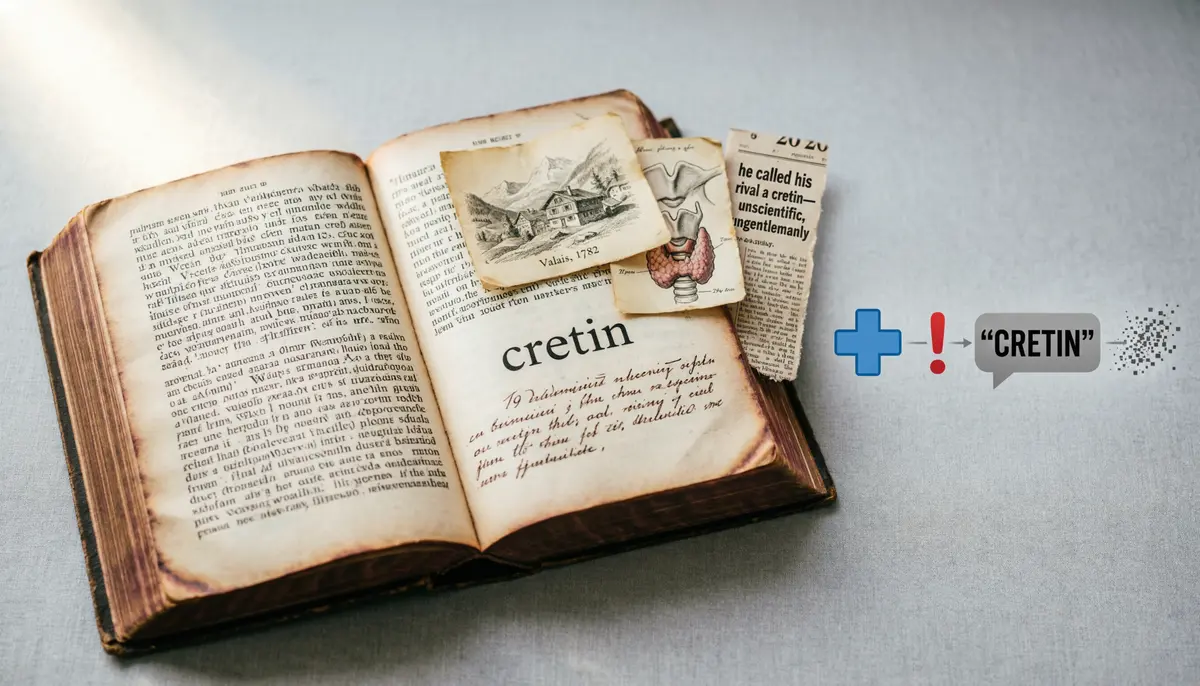
Cretin is an offensive English noun used to describe someone who is considered extremely foolish, ignorant, or lacking common sense. Today, it functions almost entirely as an insult, but the word has a much more complex history. It originally referred to people with a medical condition now known as congenital hypothyroidism, making it an outdated and inappropriate medical term. Because of this history, many dictionaries label cretin as offensive, and modern style guides generally recommend avoiding it outside discussions of language, history, or direct quotations.
A Word That Changed More Than Most
English has plenty of insults. Some have always been insulting. Others started with completely different meanings before taking on a negative life of their own.
Cretin belongs firmly in the second group.
Today, if someone calls another person a cretin, they are criticizing that person’s intelligence or judgment. The word usually suggests that someone has behaved in an exceptionally foolish, careless, or thoughtless way.
But that was not always the case.
Hundreds of years ago, the term was not intended to mock anyone. It was connected to a medical condition that affected children living in parts of Europe where iodine deficiency was common. Over time, what began as a compassionate label gradually became a medical diagnosis and eventually transformed into an insult.
That remarkable journey explains why the word carries so much historical baggage today.
Understanding both meanings helps you recognize the word in books, films, news articles, and online discussions while also knowing why many people avoid using it in everyday conversation.
What Does Cretin Mean Today?
In modern English, cretin almost always refers to a person who is perceived as exceptionally foolish or lacking good judgment.
Unlike words that criticize a single mistake, cretin often attacks the person’s intelligence as a whole.
For example:
- Only a cretin would ignore every safety warning.
- The internet quickly labeled the scammer a complete cretin.
- Stop acting like a cretin and think before you speak.
In each example, the speaker is not simply pointing out one poor decision. They are making a harsh judgment about the individual.
That is one reason dictionaries classify the word as offensive.
Simple Definition
Today, cretin generally means:
- Someone considered extremely foolish
- A person who repeatedly shows poor judgment
- An insulting term for someone viewed as unintelligent
- Someone behaving in an absurdly careless or ignorant way
Although the meaning seems straightforward, the history behind the word makes it much more sensitive than many people realize.
How to Pronounce Cretin
US Pronunciation
KREE-tin
IPA
/ˈkriːtən/
The emphasis falls on the first syllable.
Examples:
- Do not call people KREE-tins.
- The narrator pronounced the word KREE-tin.
Part of Speech
| Form | Usage |
|---|---|
| Noun | cretin |
| Plural | cretins |
| Adjective | cretinous |
| Historical noun | cretinism (obsolete medical term) |
Examples:
- He called the driver a cretin.
- They dismissed the idea as cretinous.
- Modern medicine no longer uses the term cretinism.
The Story Behind the Word
One of the most surprising things about cretin is that it began as a word intended to show compassion.
Most language experts trace it back to regional French dialects spoken in parts of Switzerland and southeastern France.
Those dialect words were themselves connected to the Latin word Christianus, meaning Christian.
At first, that seems confusing.
Why would a word related to Christian eventually become an insult?
The answer reflects the beliefs of medieval communities.
People living in isolated Alpine villages often saw children born with developmental conditions caused by severe iodine deficiency. Rather than defining those individuals by their disabilities, local communities emphasized that they were fellow human beings worthy of dignity and kindness.
Calling someone a Christian reminded others that every person deserved respect regardless of physical or intellectual differences.
Ironically, centuries later, the same word followed a very different path.
The Medical History Most People Never Learn
Long before scientists understood the importance of iodine, many mountainous regions had naturally iodine-poor soil.
Without enough iodine, the thyroid gland could not produce the hormones needed for healthy growth and brain development.
Children born with severe thyroid hormone deficiency often experienced:
- Delayed physical growth
- Developmental disabilities
- Hearing difficulties
- Speech impairments
- Skeletal abnormalities
- Learning difficulties
For generations, doctors used the word cretin to describe people affected by this condition.
It was not originally meant as an insult.
It was simply the accepted medical terminology of the time.
Medical science eventually discovered the underlying cause, and today’s healthcare professionals use the far more accurate term congenital hypothyroidism.
Because the old word became widely used as an insult, modern medicine abandoned it decades ago.
From Compassion to Insult: How the Meaning Changed
Very few English words have experienced such a dramatic shift in meaning.
Here is a simplified timeline.
Middle Ages
A regional French word connected with Christian emphasizes shared humanity.
↓
1700s
English adopts cretin as a medical term.
↓
1800s
The diagnosis becomes widely recognized throughout Europe.
↓
Early 1900s
People begin using the medical label as an insult.
↓
Today
The medical meaning has disappeared almost entirely.
The insulting meaning has become dominant.
This pattern is not unique.
Several English words that once appeared in medical textbooks eventually became everyday insults.
We will compare those later in the article.
Why Is the Word Considered Offensive?
Many people assume it is offensive simply because it is an insult.
That is only part of the story.
There are actually two reasons.
It attacks someone’s intelligence.
Unlike criticizing a specific action, calling someone a cretin suggests that the person themselves lacks intelligence or common sense.
That makes the insult feel far more personal.
It has historical ties to disability.
The word once described people with genuine medical conditions.
Over time, society transformed that medical label into an insult.
Many disability advocates point to this pattern as an example of ableist language, where words connected to disability become casual ways of insulting others.
Even speakers who do not know the history may unintentionally reinforce that legacy.
For that reason, many writers, educators, and editors recommend choosing more precise language instead.
What Does Ableist Language Mean?
One reason discussions about cretin continue today is because of its connection to ableism.
Ableist language refers to words or expressions that demean, stereotype, or insult people based on disabilities or medical conditions.
English contains several words that followed a similar path:
- idiot
- imbecile
- moron
- cretin
Each of these once had technical or clinical meanings before becoming insults.
Modern style guides increasingly encourage people to criticize actions instead of using labels rooted in disability.
For example, instead of saying:
He is a complete cretin.
You could say:
- That decision was reckless.
- The choice showed poor judgment.
- That was an irresponsible thing to do.
These alternatives communicate criticism without relying on outdated medical language.
Is Cretin Still Used by Doctors?
No.
Modern healthcare professionals do not use the word.
Instead, they use precise medical diagnoses such as:
- congenital hypothyroidism
- congenital iodine deficiency disorders
- thyroid hormone deficiency
These terms accurately describe medical conditions without carrying centuries of stigma.
As a result, you will rarely encounter cretin in current medical literature except when discussing historical terminology.
Who Still Uses the Word Today?
Although much less common than it once was, cretin has not disappeared completely.
Today you are most likely to encounter it among:
- Writers of crime novels
- Political commentators
- Satirical columnists
- Older British speakers
- Internet users making sarcastic remarks
- Fans of classic literature
- People quoting films or television dialogue
Compared with words like idiot or jerk, cretin sounds more old-fashioned.
That slightly vintage quality is one reason some speakers use it ironically rather than literally.
How Cretin Is Used on Social Media
Even though cretin is not one of today’s trendiest insults, it still appears regularly across social media platforms. Unlike slang terms that come and go within months, cretin has survived because it sounds sharper, more literary, and slightly old-fashioned.
You will often see it used when someone wants to express frustration without resorting to profanity.
Examples include comments like:
- Only a complete cretin would believe that fake headline.
- Some cretin parked across two disabled parking spaces.
- The scam fooled thousands of people because one cretin started spreading misinformation.
On platforms such as Reddit, X, YouTube, and discussion forums, the word usually appears in debates about politics, sports, technology, or viral videos.
Compared with insults like idiot or moron, cretin often carries a sarcastic, almost theatrical tone. Some users choose it precisely because it sounds less common and more dramatic.
However, because of its historical connection to disability, many online communities discourage its use. Moderators in some forums may remove comments containing ableist language, while others allow the word if it is not directed at another user.
Does Cretin Count as Slang?
Not exactly.
Although you will find cretin in slang dictionaries and online glossaries, it is not modern internet slang in the same way as words like cringe, NPC, rizz, or delulu.
Instead, it is better described as an informal insult.
Unlike internet slang, which often originates on social media, cretin has existed in English for centuries. Today’s online communities have simply adopted it as another way to criticize foolish behavior.
That means the word works across many :
- Casual conversation
- Online arguments
- Fiction
- Opinion writing
- Satire
- Comedy
Regional Differences
The word is understood throughout the English-speaking world, but how often it is used varies from one country to another.
United Kingdom
British English uses cretin more frequently than American English. It sometimes appears in newspapers, political commentary, television comedies, and everyday conversation, especially among older speakers.
British humor often favors colorful insults, and cretin fits naturally alongside words like twit, git, or numpty.
Example:
- Some cretin left the gate open again.
United States
Americans generally recognize the word but use it less often. Most speakers are more likely to say:
- idiot
- jerk
- fool
- moron
When cretin does appear, it is often found in novels, movies, or online discussions rather than casual conversation.
Australia and New Zealand
The word is understood but relatively uncommon. Australians often prefer local expressions such as drongo, galah, or nong when joking about someone’s poor judgment.
Canada
Canadian English follows a pattern similar to American English. Most people understand the word, but it is rarely heard in everyday conversation.
Is the Word Becoming Less Common?
Yes.
Compared with several decades ago, cretin has become noticeably less common.
There are several reasons for this decline.
First, awareness of respectful language has increased. Many people now recognize that some traditional insults originated as medical or disability-related terms.
Second, newer expressions dominate online conversations.
Younger speakers are more likely to use words such as:
- clown
- NPC
- cringe
- bozo
- clown behavior
As a result, cretin often sounds old-fashioned, even though most English speakers still understand it.
Pop Culture and Literary Usage
Although the word is not especially common in modern entertainment, it still appears in:
- Detective novels
- Historical fiction
- Political satire
- British television
- Newspaper opinion columns
Authors often choose cretin because it immediately tells readers something about the speaker.
A polite character probably would not use it.
A sarcastic professor, irritated detective, pompous politician, or frustrated villain just might.
In these situations, the insult helps develop a character’s personality rather than simply insulting another character.
Readers should remember that fictional dialogue reflects the speaker’s personality, not necessarily the author’s own views.
Common Expressions With Cretin
Native speakers often strengthen the insult by adding adjectives.
Common combinations include:
- complete cretin
- absolute cretin
- total cretin
- ignorant cretin
- clueless cretin
- miserable cretin
Example Sentences
- Only a complete cretin would ignore repeated safety warnings.
- The newspaper quoted an angry customer who called the scammer an absolute cretin.
- She muttered that whoever designed the confusing website must be a total cretin.
Cretin vs. Other Similar Words
Many English insults seem interchangeable, but each has its own meaning and history.
| Word | Meaning Today | Typical Tone |
|---|---|---|
| Fool | Makes poor decisions | Mild |
| Silly | Lacks seriousness | Lighthearted |
| Airhead | Forgetful or absent-minded | Casual |
| Idiot | Very foolish | Strong |
| Moron | Extremely foolish, historically a medical term | Offensive |
| Imbecile | Very unintelligent, historically a medical term | Offensive |
| Cretin | Extremely foolish or insensitive, historically a medical term | Offensive |
| Jerk | Rude or inconsiderate | Focuses on behavior |
One important difference stands out.
A jerk behaves badly.
A cretin is accused of lacking intelligence.
Someone can be rude without being foolish, and someone can make foolish decisions without intentionally treating others badly.
How Harsh Is the Word?
If we compare common English insults by intensity, the scale might look something like this.
| Mild | Moderate | Strong |
|---|---|---|
| Silly | Fool | Idiot |
| Airhead | Dimwit | Moron |
| Goof | Blockhead | Imbecile |
| Clown | Nitwit | Cretin |
This is not an official ranking, but it reflects how many native speakers perceive these words today.
Because of its history and tone, cretin usually feels stronger than fool, goof, or airhead.
Better Alternatives
If your goal is simply to criticize someone’s actions, there are usually better choices.
Instead of saying:
He is a complete cretin.
Consider saying:
- He made a careless decision.
- That was irresponsible.
- The choice showed poor judgment.
- She acted recklessly.
- That was not very thoughtful.
- They handled the situation badly.
These alternatives describe behavior rather than attacking a person’s intelligence.
They are also more appropriate in workplaces, classrooms, and professional writing.
Should English Learners Use This Word?
Generally, no.
It is useful to recognize the word because you may encounter it in:
- Novels
- Films
- Newspaper articles
- Dictionaries
- Historical writing
- Online discussions
However, most English learners do not need to use it in conversation.
Words such as careless, thoughtless, reckless, or foolish communicate criticism more clearly while avoiding unnecessary offense.
Understanding a word is often more valuable than actively using it.
Common Mistakes People Make
Thinking It Is Still a Medical Term
Modern doctors no longer use cretin as a diagnosis.
The correct medical term is congenital hypothyroidism.
Assuming It Is Harmless
Some people use the word jokingly without realizing its history.
Depending on the audience, it may be interpreted as insensitive.
Using It at Work
Insults rarely belong in professional communication.
Criticizing actions instead of people is usually more effective.
Confusing It With Jerk
A jerk behaves badly.
A cretin is criticized for a perceived lack of intelligence.
The two words are not interchangeable.
Key Takeaways
- Cretin is an offensive noun describing someone viewed as extremely foolish or lacking common sense.
- The word originally referred to people with what is now called congenital hypothyroidism.
- Modern medicine abandoned the term decades ago because it became stigmatizing.
- Today it appears mainly in fiction, dictionaries, historical discussions, satire, and online arguments.
- British English generally uses the word more often than American English.
- Many writers recommend avoiding the term because of its connection to disability-related language.
- In most situations, describing someone’s behavior is more respectful and more precise than using an insult.
Final Thoughts
The history of cretin is a reminder that language evolves in unexpected ways. A word that once reflected compassion gradually became a medical label and later transformed into a harsh insult. That evolution explains why many dictionaries now mark it as offensive and why modern medical professionals no longer use it.
Today, you are most likely to encounter cretin in older literature, British media, opinion pieces, or heated online discussions. Knowing its background helps you understand not only what the word means but also why many people choose different language when criticizing someone’s actions.
In most everyday situations, it is more effective and more respectful to focus on the behavior rather than label the person. Doing so communicates your point clearly while avoiding a term with a long and complicated history.
Frequently Asked Questions
Is cretin a swear word?
No. It is not profanity, but it is widely considered an offensive insult because it attacks a person’s intelligence and has historical medical origins.
Is cretin still used in medicine?
No. Healthcare professionals now use precise terms such as congenital hypothyroidism instead.
Is cretin worse than idiot?
Many people consider it harsher because of its historical association with disability and its less common, more cutting tone.
Can I use cretin in professional writing?
It is best avoided. In most professional contexts, describing the specific behavior is clearer and more respectful than using personal insults.
Why do dictionaries still include the word?
Dictionaries document how language is used, including historical and offensive words. Listing a word does not mean dictionaries recommend using it.
