Quick Answer
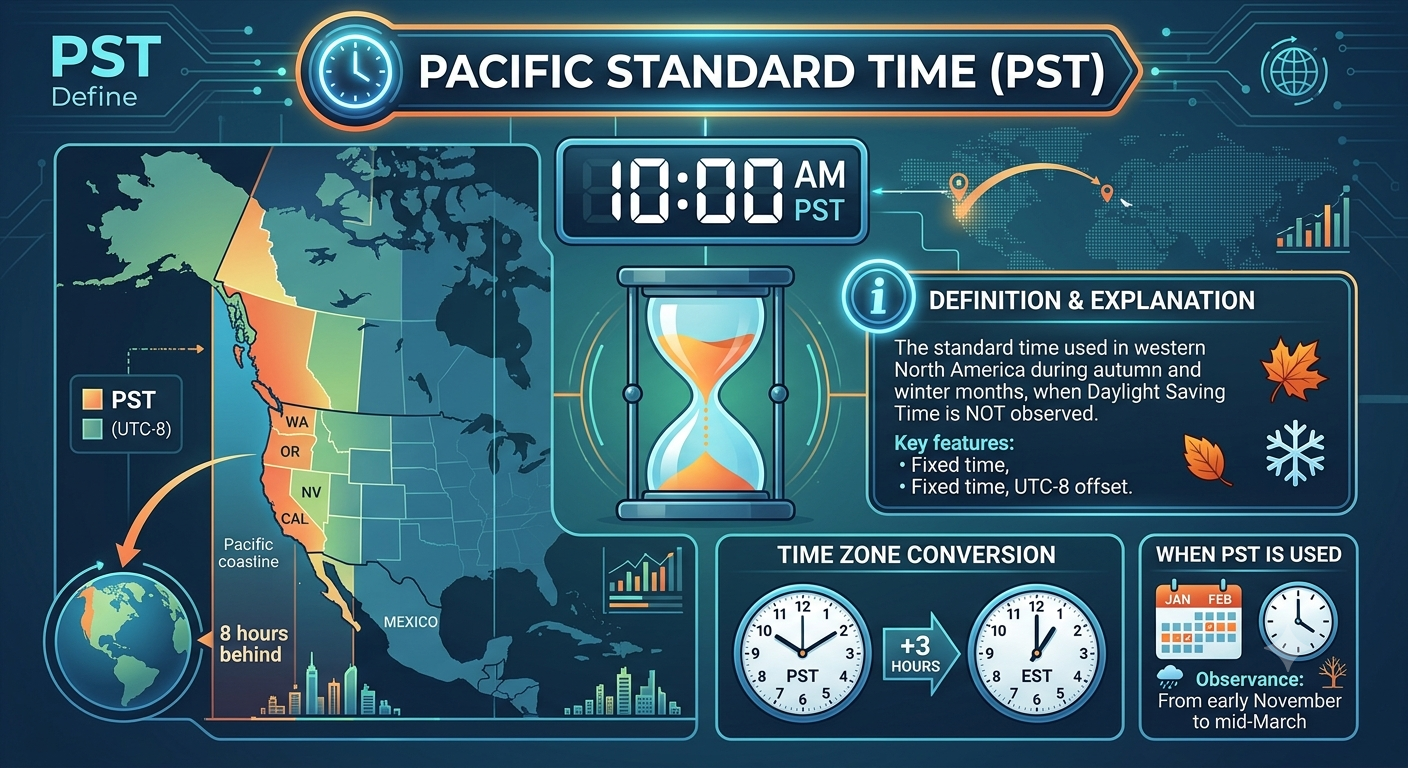
PST stands for Pacific Standard Time and means the standard time used in parts of the western region of North America during the non daylight saving period. It is eight hours behind Coordinated Universal Time, often written as UTC minus 8. People commonly use PST when scheduling meetings, events, broadcasts, flights, and online activities across different time zones.
Introduction
Many people search for pst define when they see the abbreviation in emails, business meetings, online events, social media posts, or travel schedules. Understanding PST helps avoid confusion when coordinating activities with people in different regions.
The term appears frequently in professional communication, streaming schedules, gaming communities, and customer support announcements. In this guide, you will learn what PST stands for, what it means, where people use it, how it compares to other time zones, and why understanding it can help you manage time more effectively.
What Does PST Mean?
PST stands for Pacific Standard Time.
It is a time zone used in parts of western North America during the standard time period of the year. PST is eight hours behind Coordinated Universal Time, which is written as UTC minus 8.
When someone says an event starts at 3:00 PM PST, they mean the event follows Pacific Standard Time.
What Does PST Stand For?
The full form of PST is Pacific Standard Time.
The abbreviation breaks down as follows:
- P = Pacific
- S = Standard
- T = Time
People use this abbreviation because it is shorter and easier to write than the full term.
Where Is PST Used?
PST is used in several locations that follow the Pacific Time Zone during standard time.
Some examples include:
- Parts of the western United States
- Parts of western Canada
- Certain regions that observe Pacific Time
Businesses, organizations, and online platforms often reference PST when announcing schedules.
What Is UTC Minus 8?
UTC stands for Coordinated Universal Time, the global standard used for timekeeping.
PST equals:
UTC minus 8 hours
This means if UTC is 8:00 PM, PST is 12:00 PM noon.
Understanding UTC offsets helps people convert time zones accurately.
Why Do People Use PST?
People use PST to coordinate activities across different locations.
Common reasons include:
- Scheduling meetings
- Planning online events
- Streaming broadcasts
- Booking flights
- Customer support hours
- Business communication
Using a specific time zone reduces misunderstandings.
PST in Business Communication
Businesses often mention PST when communicating with employees, customers, or partners.
Examples include:
- Webinar starts at 10:00 AM PST
- Customer support available until 6:00 PM PST
- Project deadline is 5:00 PM PST
Including the time zone helps everyone stay aligned.
PST in Online Events
Many virtual events list schedules using PST.
This is common for:
- Conferences
- Live streams
- Product launches
- Gaming tournaments
- Online classes
Participants from other regions can convert PST to their local time.
PST in Gaming Communities
Gamers frequently encounter PST when checking event schedules.
Examples include:
- Server maintenance begins at 2:00 AM PST
- Tournament starts at 5:00 PM PST
- Game update releases at midnight PST
Knowing PST helps players join events on time.
PST in Social Media
Social media platforms and content creators often announce posting schedules using PST.
For example:
- Live Q and A at 7:00 PM PST
- New video releases at 10:00 AM PST
- Special event starts at 5:00 PM PST
Followers worldwide can convert the time accordingly.
PST vs PDT
Many people confuse PST with PDT.
PST refers to Pacific Standard Time, while PDT refers to Pacific Daylight Time.
During daylight saving months, many Pacific Time locations switch from PST to PDT.
Comparison Table
| Term | Full Form | UTC Offset | Used During |
|---|---|---|---|
| PST | Pacific Standard Time | UTC minus 8 | Standard time period |
| PDT | Pacific Daylight Time | UTC minus 7 | Daylight saving period |
| EST | Eastern Standard Time | UTC minus 5 | Eastern regions |
| CST | Central Standard Time | UTC minus 6 | Central regions |
| MST | Mountain Standard Time | UTC minus 7 | Mountain regions |
How to Convert PST to Other Time Zones
Converting PST is simple once you know the time difference.
For example:
- PST to EST = Add 3 hours
- PST to CST = Add 2 hours
- PST to MST = Add 1 hour
- PST to UTC = Add 8 hours
Time conversion tools can make the process even easier.
When Is PST Used?
PST is used during the standard time portion of the year.
When daylight saving time begins, many regions switch to PDT.
This seasonal change is why checking the correct abbreviation matters.
Common Examples of PST
You may see PST used in situations like:
- Meeting invitations
- Airline schedules
- Conference registrations
- Product announcements
- Streaming schedules
- Event calendars
These examples show how common PST is in everyday communication.
Why Understanding PST Is Important
Understanding PST helps prevent scheduling mistakes.
Without knowing the time zone, people may:
- Join meetings late
- Miss events
- Misunderstand deadlines
- Confuse appointment times
A basic understanding of PST improves coordination and planning.
Is PST Used Worldwide?
PST itself is not used worldwide.
However, people around the world often encounter PST because many international companies, technology firms, and online platforms operate according to Pacific Time schedules.
As a result, users everywhere may need to convert PST into local time.
PST in Emails and Messages
Many professional emails include PST when discussing deadlines or meeting times.
Example:
“Please submit your report before 4:00 PM PST.”
Adding the time zone ensures recipients understand the exact deadline.
PST and Travel Planning
Travelers frequently encounter PST when booking transportation.
Examples include:
- Flight departures
- Hotel check in times
- Tour schedules
- Transportation services
Knowing the correct time zone helps avoid missed reservations.
Common Mistakes People Make With PST
Several mistakes occur when people use PST.
These include:
- Confusing PST with PDT
- Forgetting daylight saving changes
- Using the wrong time conversion
- Assuming PST is the same as local time
Checking the abbreviation carefully helps avoid these errors.
Related Time Zone Terms
When learning about PST, you may also encounter:
- PDT (Pacific Daylight Time)
- UTC (Coordinated Universal Time)
- GMT (Greenwich Mean Time)
- EST (Eastern Standard Time)
- CST (Central Standard Time)
- MST (Mountain Standard Time)
These terms often appear together in scheduling discussions.
Can PST Have Other Meanings?
Yes, PST can represent other phrases in specialized fields.
Examples include:
- Personal Storage Table in technology
- Professional Services Team in business
- Philippine Standard Time in certain contexts
However, when most people search for pst define, they usually mean Pacific Standard Time.
How to Use PST Correctly
To use PST correctly:
- Include the abbreviation after the time
- Verify whether standard time applies
- Double check international conversions
- Clarify the date and time when scheduling events
These simple steps reduce confusion.
Frequently Asked Questions About PST
Is PST the same as Pacific Time?
Not exactly. Pacific Time refers to the overall time zone, while PST specifically refers to the standard time period within that zone.
What is PST in UTC?
PST is UTC minus 8 hours.
Why do companies use PST?
Companies use PST because many businesses and technology organizations operate in regions that follow Pacific Time.
Does PST change during the year?
Many areas switch between PST and PDT depending on daylight saving rules.
Conclusion
PST stands for Pacific Standard Time and refers to a time zone that operates at UTC minus 8 hours during the standard time period of the year. It is widely used for business communication, online events, travel schedules, customer support hours, and digital content announcements. Understanding PST helps you convert times accurately, avoid scheduling mistakes, and communicate more clearly across different regions. Whether you encounter PST in an email, meeting invitation, flight schedule, or online event, knowing its meaning makes it easier to stay organized and on time.
