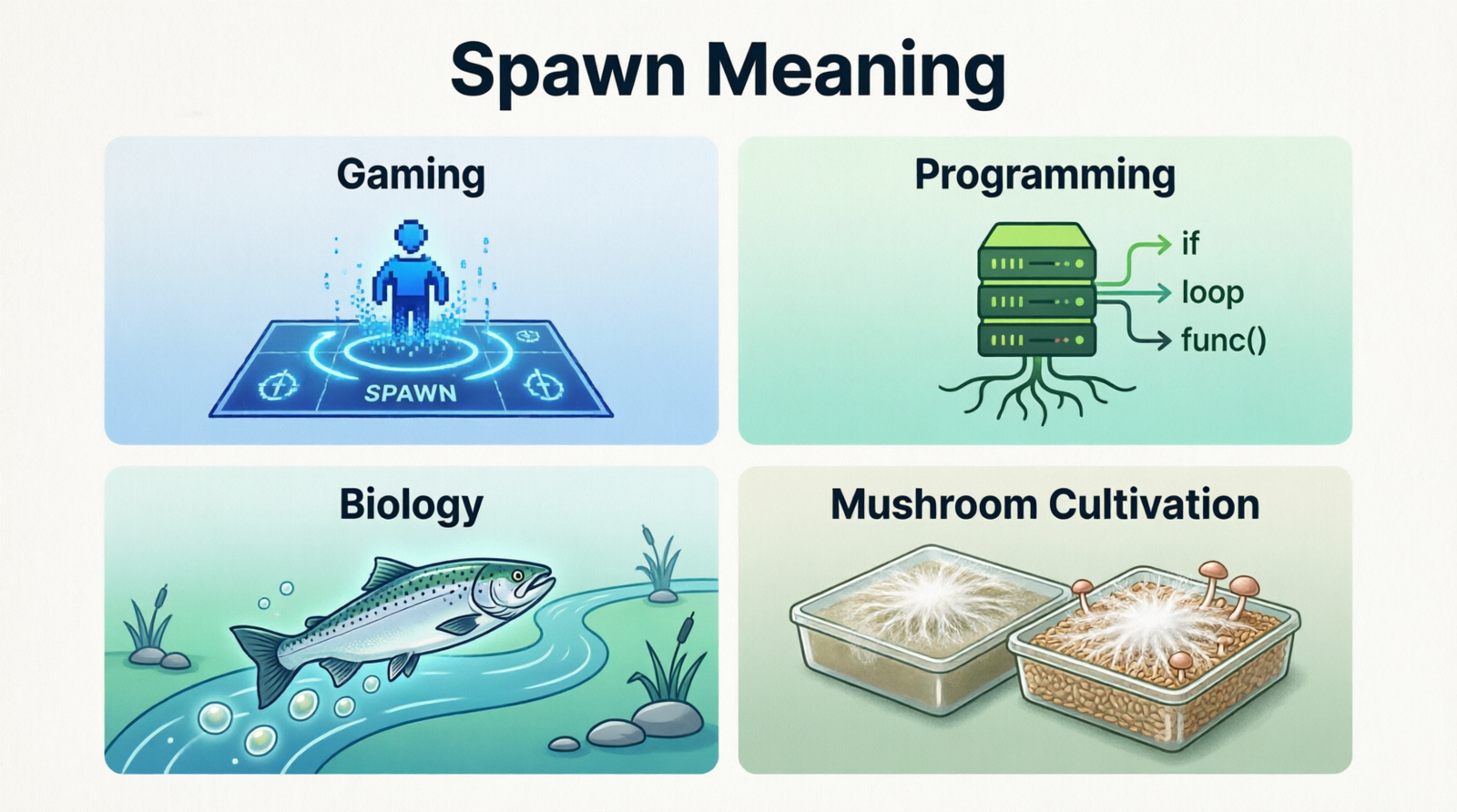
If you’ve spent any time playing online games, you’ve almost certainly seen the word spawn. A teammate says, “I’ll spawn in five seconds.” A game guide tells you where a rare boss spawns. Someone warns you not to stand near the enemy spawn. For many people, gaming is where they first encounter the term.
But that’s only one piece of the story.
The word spawn has been part of the English language for centuries. Long before video games existed, people used it to describe fish laying eggs. Today, it appears in software development, mushroom farming, science, news articles, and everyday conversations. One word has found a place in several completely different fields while keeping a surprisingly consistent core meaning.
So what does spawn actually mean?
The short answer is simple. Spawn means to create, produce, generate, or cause something to appear. The exact definition depends on the situation, but every use shares the same basic idea: something new comes into existence.
In this guide, you’ll learn every major meaning of spawn, where the word came from, how gamers and programmers use it, and why it’s become one of the most recognizable terms in modern technology and internet culture.
Spawn Meaning at a Glance
Although the definition changes with context, here’s a quick overview.
| Context | Meaning |
|---|---|
| Gaming | A player, enemy, item, or object appears in the game. |
| Biology | Fish or aquatic animals release eggs, or the eggs themselves. |
| Programming | A program creates a new process, thread, or task. |
| Mushroom Farming | Material used to grow mushrooms. |
| Everyday English | To cause something new to develop or happen. |
Once you understand this pattern, every use of the word becomes much easier to recognize.
How Do You Pronounce Spawn?
Spawn is pronounced:
spawn
It rhymes with words like:
- dawn
- lawn
- yawn
- gone (in many English accents)
The word contains just one syllable, making it easy to say and remember.
Is Spawn a Noun or a Verb?
One reason people get confused is that spawn works as both a verb and a noun.
Spawn as a Verb
When used as a verb, spawn means:
- create
- produce
- generate
- bring into existence
- cause something to appear
Examples include:
- The update spawned several unexpected bugs.
- The game spawned another enemy wave.
- Their discussion spawned a new business idea.
- Salmon spawn every autumn.
In every sentence, something new is being created or appearing.
Spawn as a Noun
As a noun, spawn usually refers to reproductive material or something used to begin growth.
Examples include:
- Frog spawn floated across the pond.
- Scientists studied salmon spawn.
- The farmer purchased mushroom spawn.
The meaning depends entirely on the topic being discussed.
Word Forms You Should Know
Like many English words, spawn changes form depending on how it’s used.
| Word | Meaning |
|---|---|
| Spawn | Base form |
| Spawns | Present tense |
| Spawned | Past tense |
| Spawning | Present participle |
| Spawner | Something or someone that creates or produces |
Examples:
- The monster spawned behind the castle.
- Fish are spawning this season.
- The server automatically spawns enemies every few minutes.
Learning these forms helps you recognize the word in conversations, articles, and game guides.
Where Did the Word Spawn Come From?
Many people assume spawn was invented by game developers.
It wasn’t.
The history of the word stretches back hundreds of years. English speakers were using spawn long before computers, consoles, or online multiplayer games existed.
Originally, the word referred to the eggs produced by fish and other aquatic animals. Fishermen talked about spawning seasons. Scientists studied spawning behavior. Governments even created fishing regulations to protect spawning grounds during breeding periods.
The exact linguistic roots trace through Middle English and Anglo-French before connecting with older Latin influences related to spreading or scattering. That makes sense when you think about fish releasing thousands of eggs into rivers and lakes.
For centuries, this biological meaning was the primary definition.
Everything changed once computers entered the picture.
How Spawn Became a Gaming Word
During the 1980s and early 1990s, video games became much larger and more complex. Developers needed a word to describe the exact moment when players, enemies, weapons, or objects appeared inside a digital world.
The existing English word spawn fit perfectly.
Instead of describing fish producing offspring, it now described digital characters appearing inside a virtual environment.
One of the earliest well-known examples came from classic first-person shooters like Doom, where players and monsters appeared at designated locations throughout the map.
As gaming evolved, the vocabulary expanded along with it.
Players began using terms such as:
- spawn point
- respawn
- spawn timer
- spawn protection
- spawn camping
- boss spawn
- mob spawn
Today, it’s difficult to discuss multiplayer games without hearing the word spawn several times.
Whether you’re playing an online shooter, an MMORPG, a survival game, or a sandbox title, spawning systems control nearly everything that appears around you.
And that’s exactly where we’ll continue next.
Spawn Meaning in Video Games
Today, gaming is the first place most people encounter the word spawn.
In video games, spawn means a player, enemy, NPC, vehicle, weapon, item, resource, or any other object appears in the game world. Sometimes this happens automatically. Other times it only occurs after specific conditions are met.
Here are a few common examples:
- Your character spawns when the match begins.
- A rare boss spawns after the dungeon is cleared.
- Health packs spawn every few minutes.
- Zombies spawn during the night.
- Loot spawns randomly across the map.
Without spawning systems, modern games would feel empty. Every enemy you fight, every treasure chest you discover, and every teammate you meet exists because the game decides when and where those objects should appear.
What Is a Spawn Point?
A spawn point is the exact location where something first appears.
Depending on the game, that could be:
- A player’s starting position
- An enemy location
- A weapon location
- A vehicle spawn
- A collectible item
- An NPC location
For example:
- Meet me at the east spawn.
- The boss has two possible spawn points.
- That weapon always spawns near the bridge.
Competitive games usually give each team its own spawn area to keep the match fair. Open-world games often hide spawn points from players so the world feels more natural.
Different Types of Spawn Systems
Not every game handles spawning the same way. Developers choose different systems depending on the type of gameplay they want players to experience.
Fixed Spawn
A fixed spawn always appears in the same place.
Examples include:
- Important quest items
- Story characters
- Mission objectives
- Certain bosses
After playing for a while, experienced players memorize these locations.
Random Spawn
Random spawning selects from multiple possible locations.
This system is common in:
- Battle royale games
- Survival games
- Open-world adventures
Because items appear in different places each match, players can’t rely on memorization alone.
Timed Spawn
Some objects only appear after a specific amount of time.
Examples include:
- Treasure chests
- World bosses
- Resource nodes
- Enemy waves
- Seasonal events
Players often track these timers so they can arrive just before valuable rewards appear.
Event-Based Spawn
Some enemies only spawn after players complete certain objectives.
For example:
- Finish every puzzle.
- Defeat all nearby enemies.
- Activate an ancient shrine.
- Complete a quest.
This approach rewards exploration instead of simply waiting in one location.
Conditional Spawn
Some games check special requirements before allowing an object to appear.
Conditions might include:
- Time of day
- Weather
- Player level
- Biome
- Completed achievements
- Possession of a rare item
Many RPGs use conditional spawning to make legendary creatures feel genuinely rare.
Why Spawning Matters
Spawning isn’t just about making enemies appear.
It plays a huge role in game design.
A well-designed spawning system helps developers:
- Balance multiplayer matches
- Control difficulty
- Improve game performance
- Prevent overcrowding
- Encourage exploration
- Keep the world feeling alive
Imagine an open-world game where every creature existed from the beginning. Your computer or console would have to process thousands of active characters all at once.
Instead, the game only spawns nearby enemies as you explore. This saves memory and keeps performance smooth without most players ever noticing what’s happening behind the scenes.
Spawn vs. Respawn
One of the most common questions gamers ask is whether spawn and respawn mean the same thing.
They don’t.
Spawn is the first appearance of a player, enemy, or object.
Respawn means appearing again after being defeated, destroyed, or removed.
For example:
- The match begins.
- Your character appears.
- You have spawned.
Later:
- Your character is eliminated.
- A countdown begins.
- You return to the game.
- You have respawned.
An easy way to remember the difference is this:
Spawn = first appearance
Respawn = coming back after disappearing
What Is Spawn Camping?
Among competitive gamers, spawn camping is one of the most recognized gaming terms.
Spawn camping happens when players wait near an opponent’s spawn point and eliminate them immediately after they appear.
Instead of allowing opponents time to move or defend themselves, campers repeatedly attack as soon as players spawn.
For example:
“We couldn’t leave our base because they were spawn camping.”
Many players consider this frustrating because victims have little chance to react before dying again.
To reduce the problem, developers often redesign maps or introduce protective mechanics.
Spawn Trapping vs. Spawn Camping
These two terms are related but not identical.
Spawn camping usually involves waiting near one spawn location.
Spawn trapping goes further.
A team controls every exit from the spawning area, making escape nearly impossible.
Players become trapped inside their own base and are eliminated repeatedly.
This situation often creates one-sided matches, so developers regularly update maps to prevent it.
What Is Spawn Protection?
Many multiplayer games include spawn protection to make matches fairer.
Spawn protection gives newly spawned players temporary immunity.
This protection usually lasts only a few seconds or disappears as soon as the player attacks.
The goal is simple.
It gives players enough time to move away from danger before becoming vulnerable again.
Without spawn protection, many online games would become frustrating very quickly.
Spawn Rate and Spawn Timer
Two other terms you’ll hear frequently are spawn rate and spawn timer.
A spawn rate describes how often something appears.
For example:
- Common enemies have a high spawn rate.
- Rare bosses have a low spawn rate.
- Valuable loot usually has a limited spawn rate.
A spawn timer measures how long players must wait before something appears again.
Examples include:
- A world boss respawns every 30 minutes.
- A treasure chest has a 10-minute spawn timer.
- Resources reset every five minutes.
Experienced players often memorize these timers to farm rare items more efficiently.
In games where valuable rewards are limited, knowing spawn timers can provide a significant advantage.
How Popular Games Use Spawn Mechanics
Different games use spawning systems in their own way. While the basic idea stays the same, each title adjusts it to match its gameplay.
Minecraft
Minecraft introduced millions of players to the word spawn.
Some of the most common spawn-related terms include:
- World Spawn – The default location where players first enter a world.
- Spawn Point – A personal respawn location that can be changed by sleeping in a bed or using a respawn anchor.
- Spawn Egg – A special item that instantly creates a specific mob.
- Mob Spawning – Animals and hostile creatures appear naturally based on light levels, biome, distance from players, and the time of day.
Understanding these mechanics helps players build better farms, survive longer, and collect resources more efficiently.
Fortnite
In Fortnite, every player spawns before boarding the Battle Bus.
Some game modes allow players to respawn after elimination, while others eliminate them permanently until the match ends. Epic Games regularly adjusts spawning rules to keep matches balanced.
PUBG
PUBG begins with everyone spawning on Spawn Island before the actual match starts.
Once players jump onto the main map, there are no respawns in standard Battle Royale mode. Every decision matters because one mistake usually means the game is over.
Roblox
Roblox creators can place SpawnLocation objects wherever they want inside their games.
These locations determine where players first appear or where they return after dying. Developers can customize these spawn points to fit different game styles.
GTA Online
After being eliminated in GTA Online, players usually respawn at a nearby safe location.
The game tries to prevent players from repeatedly appearing in dangerous areas, reducing the chances of immediate attacks.
MMORPGs
Massively multiplayer online role-playing games rely heavily on spawning systems.
You’ll commonly hear players talk about:
- Boss spawns
- Monster spawns
- Resource spawns
- Event spawns
- NPC spawns
Some rare bosses only appear after long spawn timers, making them valuable targets for organized groups.
Spawn Meaning in Biology
Long before video games existed, spawn was already an established biological term.
In biology, spawn refers to the eggs released by fish, amphibians, mollusks, and many other aquatic animals. It can also describe the act of releasing those eggs during reproduction.
Examples include:
- Salmon spawn upstream every year.
- Frogs leave spawn in shallow ponds.
- Oysters release millions of eggs into the sea.
Unlike mammals, many aquatic animals reproduce through external fertilization. Females release eggs into the water while males release sperm over them, allowing fertilization to happen outside the body.
Because many eggs never survive, species often produce thousands or even millions during a single spawning season.
Governments frequently restrict fishing during spawning periods to help protect wildlife populations and maintain healthy ecosystems.
What Is Mushroom Spawn?
Another meaning that surprises many people comes from agriculture.
In mushroom cultivation, spawn is the material used to grow mushrooms. Think of it as the starter culture that spreads mushroom mycelium throughout the growing medium.
Without mushroom spawn, commercial mushroom farming wouldn’t exist.
The most common types include:
- Grain spawn
- Sawdust spawn
- Plug spawn
- Liquid spawn
Each type is designed for different growing methods and mushroom species.
Spawn Meaning in Programming
In computer science, spawn has become a standard technical term.
When programmers say a program spawns a new process, they mean it creates another process, thread, or task that runs alongside the original one.
For example:
- A web server spawns worker processes to handle many visitors at once.
- A video editor spawns background tasks while you continue editing.
- An operating system spawns a new process whenever you launch an application.
Programming languages such as Python, Java, C++, and JavaScript all support different ways of spawning new processes or threads.
The purpose is simple: allow software to perform multiple jobs simultaneously without slowing everything down.
Spawn in Everyday English
You don’t have to play games or write code to use the word spawn.
In everyday English, it usually means to cause something new to happen or develop.
You’ll often see it in news articles and business reports.
Examples include:
- The invention spawned a completely new industry.
- The announcement spawned intense debate.
- The television series spawned several successful spin-offs.
- The discovery spawned years of scientific research.
In these examples, nothing literally appears the way a game character does. Instead, one event becomes the starting point for something else.
Spawn vs. Similar Words
Several English words have meanings close to spawn, but they aren’t always interchangeable.
Spawn usually suggests something coming into existence naturally or as the result of another event.
Create is the broadest option and works in almost every situation.
Generate is common in science and computing when something is produced automatically.
Produce often refers to making or manufacturing something.
Summon usually means intentionally calling something to appear, especially in fantasy games or mythology.
Choosing the right word depends on the context.
Common Synonyms
Depending on the situation, spawn can mean:
- Create
- Produce
- Generate
- Develop
- Bring about
- Give rise to
- Trigger
- Initiate
- Launch
- Reproduce
- Hatch
Common Antonyms
The opposite meaning may include:
- Destroy
- Remove
- Eliminate
- Prevent
- Suppress
- Erase
- End
- Stop
Common Mistakes People Make
One of the biggest misconceptions is believing spawn is only a gaming term.
While games made the word popular with younger generations, its biological meaning existed centuries earlier.
Another common mistake is confusing spawn with respawn.
Remember:
- Spawn means something appears for the first time.
- Respawn means it returns after disappearing.
Some players also mix up spawn and summon.
A summoned creature appears because someone intentionally calls it.
A spawned creature usually appears automatically because the game’s rules say it should.
Finally, don’t assume only players can spawn.
Enemies, bosses, NPCs, vehicles, loot, animals, treasure chests, and even weather events can all spawn depending on the game.
Final Thoughts
Spawn is one of those words whose meaning expands as technology changes, yet its core idea stays remarkably consistent.
Whether you’re talking about a player entering a multiplayer match, salmon reproducing in a river, mushroom growers preparing a new crop, or software launching another process, the same concept applies. Something new is being created or brought into existence.
That simple idea explains why the word has survived for centuries while adapting to completely different industries.
Today, spawn is just as comfortable in a biology textbook as it is in a gaming guide or a programming manual. Understanding the context is all you need to interpret it correctly.
Once you know that, you’ll recognize the word almost everywhere, and you’ll understand exactly what it means each time you see it.
What does spawn mean in gaming?
In gaming, spawn means a player, enemy, NPC, item, vehicle, or object appears in the game world. This can happen automatically or after specific conditions are met.
What is a spawn point?
A spawn point is the location where a player, enemy, item, or object first appears or reappears within a game.
What’s the difference between spawn and respawn?
Spawn is the first appearance of something, while respawn means it appears again after being eliminated, destroyed, or removed.
Why do games use spawning systems?
Spawning systems help balance gameplay, improve performance, control difficulty, and make game worlds feel active without loading every object at once.
What does spawn mean in biology?
In biology, spawn refers to the eggs produced by fish and other aquatic animals or the act of releasing those eggs during reproduction.
What is mushroom spawn?
Mushroom spawn is material containing mushroom mycelium that growers use to cultivate mushrooms. It acts as the starting point for mushroom growth.
What does spawn mean in programming?
In programming, spawning means creating a new process, thread, or task that runs independently or alongside an existing process.
Why is it called spawn in video games?
Game developers adopted the existing English word because it accurately describes players, enemies, and objects appearing inside a virtual world. The term already meant creating or bringing something into existence, making it a natural fit for gaming.
