Quick Answer
Youngin is an informal slang word that means a young person, child, teenager, or someone younger than the speaker. It comes from the phrase young one and has been used in African American Vernacular English (AAVE), Southern American English, and everyday conversation for generations. Depending on the situation, it can sound affectionate, humorous, encouraging, respectful, or gently teasing.
Example:
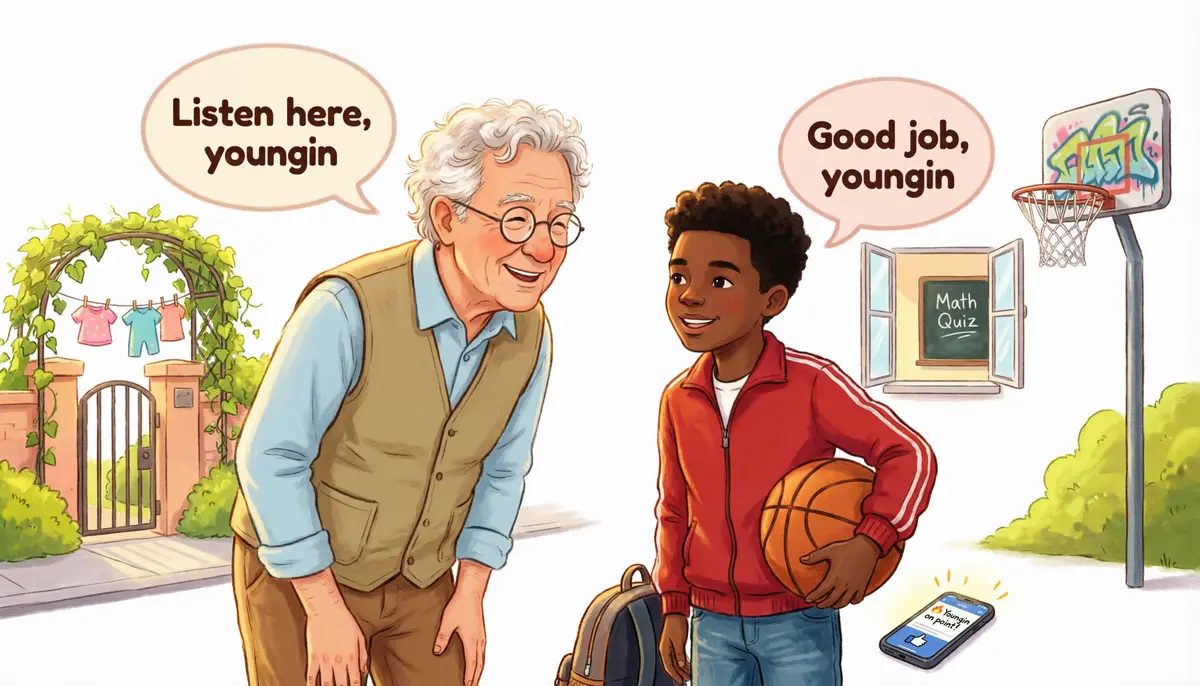
Listen here, youngin. You’ll understand when you’re older.
While the word has become more visible through social media and hip-hop culture, it is far older than TikTok or modern internet slang. Today, people use it in conversations with family members, friends, teammates, coworkers, and even online communities. The exact meaning depends on the relationship between the speaker and the person being described.
What Does Youngin Mean?
Some slang words become popular for a short time before fading away. Others remain part of everyday speech because they are simple, expressive, and easy to understand. Youngin belongs to the second group.
At its core, youngin simply refers to someone who is younger than the speaker. That person might be a small child, a teenager, a younger sibling, a new employee, or even an adult who is much younger than the person talking.
Unlike formal words such as child, youth, or juvenile, youngin feels relaxed and conversational. It is the kind of word you are far more likely to hear around the dinner table, at a neighborhood gathering, or during a casual chat than in a business meeting or academic paper.
For example, a grandfather might affectionately call his sixteen-year-old grandson a youngin. An experienced mechanic may jokingly refer to a twenty-five-year-old apprentice as the youngin in the shop. Even a forty-year-old employee could become the youngin in an office filled with coworkers approaching retirement.
This flexibility is one reason the word has remained popular for so many years. It is less about someone’s exact age and more about their age or experience compared to the speaker.
In many conversations, the word also carries an emotional tone. A parent may use it lovingly, while a coach may use it to encourage a younger athlete. Friends sometimes use it playfully when joking about age differences, and older relatives often use it with a sense of nostalgia.
Although the meaning is straightforward, the feeling behind the word changes depending on who says it and how they say it. That is part of what makes youngin such a versatile expression in everyday English.
Youngin vs. Youngins
People often wonder whether youngin and youngins mean different things. Fortunately, the difference is very simple.
| Word | Meaning | Example |
|---|---|---|
| Youngin | One young person | That youngin is learning fast. |
| Youngins | More than one young person | The youngins are playing basketball. |
Think of it this way.
One child is a youngin.
Several children are youngins.
The same rule applies when talking about teenagers, younger coworkers, or any group of younger people. If you are referring to one individual, use the singular form. If you mean two or more people, use the plural.
Examples:
That youngin already knows how to fix computers.
The youngins stayed outside until sunset.
Our new youngin at work is picking things up quickly.
The youngins on the team practiced for three hours.
Even though the plural follows normal English grammar, many people unfamiliar with the word mistakenly assume youngins has a different meaning. In reality, it simply functions like most other plural nouns.
How Do You Pronounce Youngin?
Most English speakers pronounce youngin as:
YUNG-in
Phonetic spelling: YUNG-in
Approximate IPA: /ˈjʌŋɪn/
Because the word developed through spoken English instead of formal writing, pronunciation naturally varies from one region to another. Some speakers pronounce every syllable clearly, while others shorten the ending so it sounds closer to yung’n or young-un.
These differences are perfectly normal. Local accents and dialects influence how people pronounce many informal words, and youngin is no exception.
If you hear the word in different parts of the United States, you may notice small changes in pronunciation, but the meaning remains exactly the same.
For learners of English, the easiest way to remember the pronunciation is to say young followed immediately by in. Speaking it naturally a few times usually produces the correct sound.
Where Did Youngin Come From?
Although many people associate youngin with modern slang, the word is actually much older than social media.
Its history begins with the simple phrase young one. As generations of English speakers used the phrase in everyday conversation, they naturally shortened it. Speaking quickly caused the two words to blend together until new spoken forms began to appear.
Over time, the evolution looked like this:
Young one
↓
Young’un
↓
Youngin
↓
Youngins
This type of language change happens frequently in English. Words become shorter, easier to pronounce, and more conversational as they are passed from one generation to the next.
Several alternative spellings developed along the way, including young’un, youngen, youngin’, and yungin. These spellings reflect differences in pronunciation rather than differences in meaning.
For many years, the word remained mostly part of regional speech, especially in Southern communities and African American communities. It spread naturally through families, neighborhoods, schools, churches, and local traditions long before it appeared in music or on the internet.
Eventually, television, movies, and popular culture introduced the word to a much larger audience. Today, someone living hundreds of miles away from the American South may still recognize the word because they have heard it in a song, watched it in a movie, or seen it used on social media.
The journey of youngin shows how spoken language evolves over time. Rather than being invented overnight, it slowly developed through everyday conversations until it became a familiar part of informal American English.
The AAVE Connection
An important part of the history of youngin is its connection to African American Vernacular English (AAVE).
For decades, Black communities throughout the United States have used the word as a familiar way to refer to younger people. Parents, grandparents, older siblings, neighbors, coaches, and community leaders often used it naturally in everyday conversations.
Like many expressions rooted in AAVE, youngin gradually reached a much wider audience through music, sports, entertainment, television, and popular culture.
Hip-hop played a particularly important role in introducing the word to listeners around the world. As rap music grew into a global genre during the 1980s and 1990s, many AAVE expressions became recognizable far beyond the communities where they originated.
Today, millions of people who did not grow up hearing the word use it comfortably in everyday conversation.
Understanding these cultural roots is important because it helps explain why the word feels authentic in certain . It also reminds us that many expressions considered mainstream today began within specific communities before becoming part of broader American English.
Youngin is one example of how language travels across generations, regions, and cultures while keeping its original meaning largely intact.
Is Youngin Slang?
Yes. Youngin is slang, but it is not the same type of slang as modern internet expressions like rizz, sus, NPC, or delulu.
Those words became popular primarily because of online communities and social media platforms.
Youngin followed a completely different path.
The word had already existed in spoken English for generations before smartphones, social media, or messaging apps became part of everyday life. Families were using it around kitchen tables, on front porches, in schools, and throughout neighborhoods decades before anyone posted videos online.
Instead of being created by the internet, social media simply gave youngin a much larger audience. Platforms like TikTok, Instagram, YouTube, and X helped younger generations hear and adopt a word that had already been part of American speech for many years.
Because of its long history, many language experts describe youngin as traditional informal slang or a regional dialect word rather than internet slang.
Its continued popularity proves that some expressions survive not because they become viral, but because they remain useful in everyday conversation.
What Does Youngin Usually Refer To?
The meaning of youngin changes depending on who is speaking and the situation. There is no fixed age range attached to the word. Instead, it describes someone who is younger than the speaker or someone with less life experience.
For example, an eight-year-old probably would not call another eight-year-old a youngin. However, a seventy-year-old might call a forty-year-old a youngin because the age gap is significant.
Here are the most common ways people use the word.
A Child
Parents, grandparents, teachers, and neighbors often use youngin when talking about children.
Examples:
- That little youngin loves dinosaurs.
- The youngin is already reading chapter books.
- Every youngin deserves encouragement.
A Teenager
Older adults commonly use the word for teenagers and high school students.
Examples:
- Those youngins spend too much time on their phones.
- The youngins are practicing for the school play.
- Every youngin should learn basic life skills.
Someone Younger Than the Speaker
Sometimes the word simply identifies the younger person in a conversation.
Examples:
- I remember when you were just a youngin.
- You’re still a youngin compared to me.
- Ask the youngin if he wants to join us.
Someone Inexperienced
Youngin is also used figuratively to describe someone who is still learning.
Imagine a veteran electrician talking to a new apprentice.
You’re still a youngin. Give yourself time and you’ll master it.
The apprentice might be twenty-eight years old, but compared with someone who has worked for forty years, they are still the youngin.
In these situations, the word refers to experience rather than age.
Literal Meaning vs. Figurative Meaning
One reason youngin remains popular is its flexibility. Sometimes it describes someone’s actual age, while other times it refers to their level of knowledge or experience.
Literal Meaning
When used literally, youngin refers to someone who is genuinely young.
Examples:
- The youngins are playing soccer after school.
- That youngin just started kindergarten.
- Every youngin in the neighborhood received a gift.
Figurative Meaning
Figuratively, the word can describe someone who is less experienced, even if they are an adult.
Examples:
- You’re still a youngin in this business.
- I’ve been fishing for fifty years. You’re just a youngin compared to me.
- Give the youngin some time to learn the ropes.
This figurative meaning appears frequently in workplaces, sports, and skilled trades where experience is valued as much as age.
The Tone Depends on Context
One of the most interesting things about youngin is that its tone changes depending on how it is spoken.
The word itself is neutral. The speaker’s voice, facial expression, and relationship with the listener determine whether it feels kind, funny, or insulting.
Affectionate
Many grandparents, parents, and older relatives use the word lovingly.
Example:
Come here, youngin. I want to show you something.
Encouraging
Teachers and coaches often use it to motivate younger people.
Example:
Keep working hard, youngin. You’re getting better every day.
Playful
Friends sometimes joke about age differences.
Example:
You youngins don’t remember renting movies from a video store.
Teasing
The word can also be used during lighthearted conversations.
Example:
Slow down, youngin. You’re making the rest of us look lazy.
Slightly Critical
Occasionally, youngin expresses frustration with younger generations.
Example:
These youngins think they know everything after watching one video online.
Although this use sounds more critical, it is usually aimed at a generation rather than one specific person.
Because tone matters so much, listening to the speaker is just as important as understanding the word itself.
Regional Differences: Where Is Youngin Most Common?
Although people across the United States recognize the word, some regions use it much more frequently than others.
Southern United States
The American South has used youngin for generations. It is common in everyday conversations between family members, neighbors, coaches, and longtime friends.
You may hear expressions such as:
- Come help me, youngin.
- Those youngins have been fishing since sunrise.
- You’re still a youngin. Enjoy your youth while you can.
In Southern communities, the word usually sounds warm and familiar rather than disrespectful.
African American Communities
Youngin has deep roots in African American Vernacular English.
It is commonly heard in family conversations, neighborhood discussions, churches, sports, and community events.
As hip-hop music and Black popular culture gained worldwide influence, many AAVE expressions became part of mainstream English. Youngin followed that same path.
Today, people from many backgrounds use the word, even if they first heard it in music or online.
Rural Communities
Outside large cities, youngin often appears in everyday speech.
Someone might naturally say:
That youngin helped me fix the fence.
instead of
That child helped me fix the fence.
This reflects local speaking habits rather than internet slang.
Cities and Urban Areas
In urban , the word is often used humorously to describe:
- younger coworkers
- college freshmen
- rookie athletes
- new employees
- younger relatives
The meaning stays consistent, but the situations become more varied.
Youngin on Social Media
Although youngin existed long before social media, platforms like TikTok, Instagram, Facebook, YouTube, Snapchat, and X have introduced it to millions of new users.
Today, the word often appears in humorous posts comparing different generations.
Examples include:
- These youngins will never understand dial-up internet.
- The youngins think DVDs are ancient history.
- Back in my day, youngins actually memorized phone numbers.
- Watching the youngins discover songs from the early 2000s makes me feel old.
Many memes use the word to highlight the contrast between older and younger generations.
Social media has also made alternative spellings like yungin more common, especially in captions and comments where casual spelling is accepted.
Despite this renewed popularity, the meaning has remained almost identical to what it was decades ago.
Youngin in Hip-Hop Culture
Hip-hop has played a major role in keeping youngin part of modern vocabulary.
Artists often use the word when talking about:
- younger friends
- neighborhood kids
- younger family members
- rising musicians
- inexperienced people
- younger versions of themselves
Depending on the lyrics, youngin may communicate:
- respect
- guidance
- pride
- nostalgia
- responsibility
- encouragement
For example, an artist might rap about helping the youngins in their community by sharing advice and opportunities.
Another artist might remember being a youngin while reflecting on childhood experiences and personal growth.
Because hip-hop reaches audiences around the world, many people first encounter the word through music before hearing it in everyday conversation.
The genre has helped preserve the expression while introducing it to entirely new generations of English speakers.
Can Youngin Be Offensive?
In most situations, youngin is not considered offensive. It is generally used as a friendly, familiar, or affectionate way to refer to someone younger than the speaker. Parents, grandparents, coaches, teachers, and older friends often use it without any negative intent.
However, like many informal words, tone and context make all the difference.
Consider these examples:
Friendly
Nice job, youngin. You handled that really well.
This sounds encouraging and supportive.
Affectionate
Come on, youngin. Dinner’s ready.
Here, the word expresses warmth and familiarity.
Now compare those with this example:
Sit down, youngin. You don’t know anything.
The meaning of the word hasn’t changed, but the tone has. In this case, it feels dismissive and slightly disrespectful.
The same thing can happen with words like kid, buddy, or son. They can sound caring in one conversation and patronizing in another.
If you’re speaking to someone you don’t know well, especially an adult, it’s usually best to avoid calling them a youngin unless you’re confident they’ll take it in the friendly spirit you intend.
Positive vs. Negative Uses
Although the word itself is neutral, the surrounding conversation often reveals whether it is being used positively or negatively.
Positive Examples
These examples show encouragement, pride, or affection.
- Proud of you, youngin.
- That youngin has real talent.
- Keep working hard, youngin.
- The youngins volunteered to clean the neighborhood park.
- Every youngin deserves someone who believes in them.
Neutral Examples
Sometimes the word simply describes younger people without adding emotion.
- The youngins are still at school.
- Ask the youngin if he needs help.
- The youngins arrived before everyone else.
- We invited all the youngins to the family picnic.
Negative Examples
Occasionally, the word is used while criticizing younger generations.
- These youngins don’t respect anybody.
- You’re just a youngin. What do you know?
- Youngins think everything started with social media.
- Some youngins expect success without putting in the work.
Notice that even in these examples, the negativity comes from the sentence rather than the word itself.
Common Situations Where People Say Youngin
Because youngin is such a flexible expression, you’ll hear it in many everyday situations.
At Home
Family members probably use the word more than anyone else.
Examples:
- Come eat, youngin.
- The youngins are watching cartoons.
- I remember when you were just a little youngin.
- Tell the youngins it’s bedtime.
At School
Teachers and coaches sometimes use the word in a friendly way.
Examples:
- Listen up, youngins. Class is about to begin.
- Every youngin did a great job today.
- That youngin has a bright future.
At Work
Older employees occasionally refer to newer coworkers this way.
Examples:
- The youngin learned the software in one afternoon.
- Give the youngin a chance to prove himself.
- Our newest youngin has some great ideas.
In Sports
Coaches often encourage younger athletes using the term.
Examples:
- Nice hustle, youngin.
- Keep practicing, youngin.
- That youngin is improving every game.
Around the Neighborhood
Longtime residents frequently call younger neighbors youngins, even after they become adults.
Examples:
- I remember when that youngin couldn’t ride a bicycle.
- Those youngins grew up so fast.
- Every youngin on this street used to play outside together.
These everyday situations show why the word has lasted for generations. It fits naturally into casual conversations.
Youngin in Text Messages
Unlike abbreviations such as LOL, BRB, or IMO, youngin does not have a special texting definition.
People simply type the word exactly as they would say it in conversation.
Here are some common examples.
Friend:
You coming to the barbecue?
Reply:
Yeah, I’m bringing my little youngin too.
Mom:
Where’s your brother?
Reply:
The youngin is still sleeping.
Coworker:
The new intern seems smart.
Reply:
Yeah, the youngin learns fast.
Friend:
Who’s fixing your computer?
Reply:
The youngin next door knows all about computers.
You’ll also see alternative spellings like yungin in casual texts and social media posts, but the meaning stays exactly the same.
Common Expressions Using Youngin
Some phrases have become so common that many English speakers recognize them immediately.
Here are some of the most popular expressions.
- Listen here, youngin.
- Back when I was a youngin.
- You’re still a youngin.
- These youngins today…
- That youngin has talent.
- Come on, youngin.
- Poor youngin.
- Smart youngin.
- Good kid, that youngin.
- Leave the youngins alone.
- That youngin works hard.
- Every youngin deserves a chance.
Each expression carries its own tone.
For example, Back when I was a youngin usually introduces a personal story or childhood memory.
These youngins today often begins a humorous comparison between generations.
Meanwhile, That youngin has talent is usually spoken with admiration or pride.
Different Spellings You May See
Since youngin developed through spoken English, several spellings appear in writing.
| Spelling | Notes |
|---|---|
| Youngin | Most common modern spelling |
| Youngins | Standard plural form |
| Youngin’ | Casual spelling showing dropped pronunciation |
| Young’un | Traditional spelling from young one |
| Youngen | Regional variation |
| Yungin | Popular in hip-hop and online writing |
| Yungin’ | Informal social media spelling |
These versions generally refer to the same idea.
Some writers prefer young’un because it reflects older regional speech, while younger internet users often write yungin because it matches modern pronunciation.
Neither spelling changes the meaning.
Is Yungin Different From Youngin?
Not really.
Yungin is simply an alternative spelling of youngin.
Many people choose the shorter spelling because:
- it matches everyday pronunciation
- it looks more casual
- it is common in rap lyrics
- it is quicker to type
- it fits informal social media writing
Whether someone writes youngin or yungin, they are usually referring to the same thing: a younger person or someone younger than the speaker.
The only real difference is spelling, not definition or usage.
