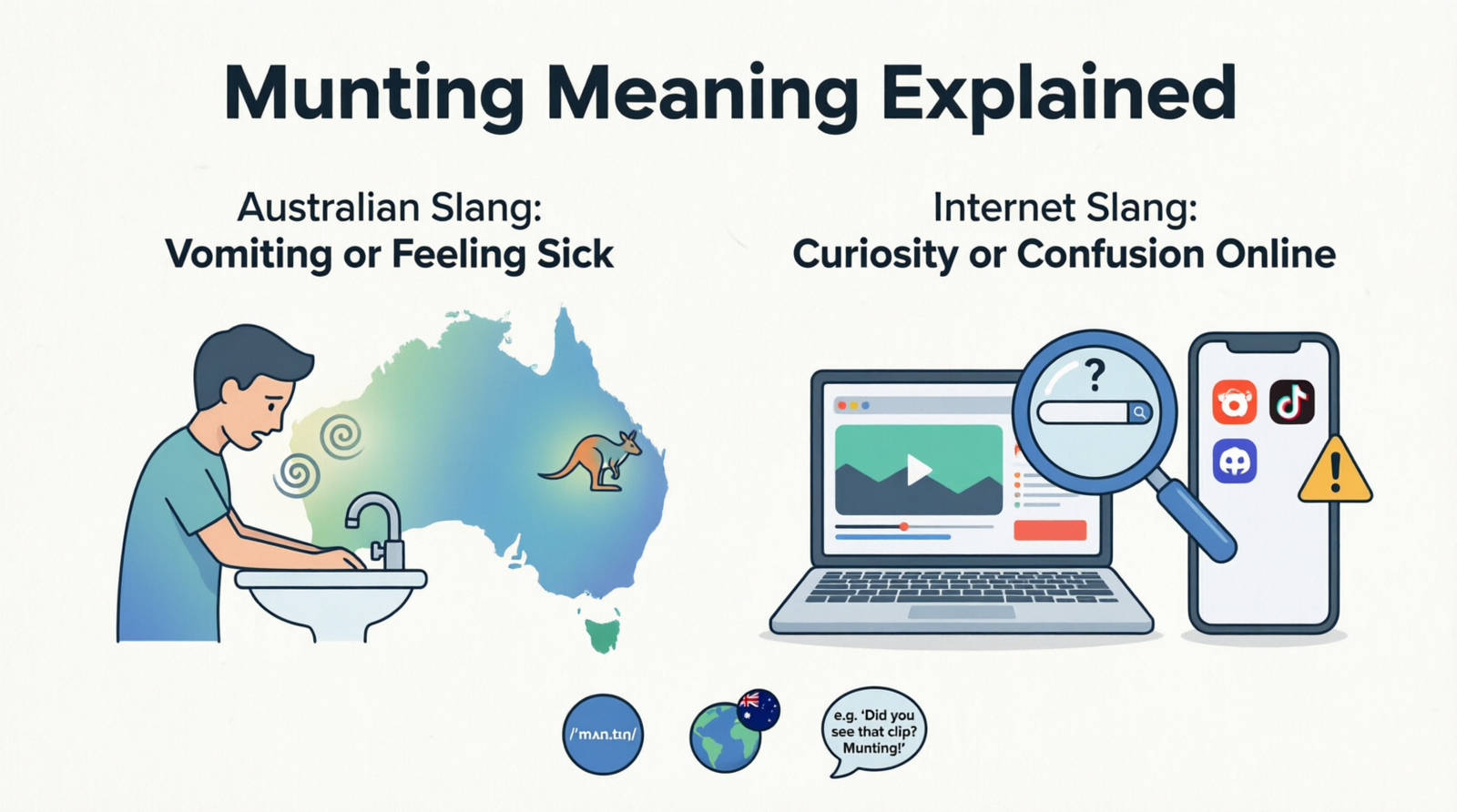
Have you ever stumbled across the word munting on TikTok, Reddit, Discord, or YouTube and wondered what everyone was talking about?
You’re not alone.
Every month, thousands of people search for munting meaning after seeing the word in a comment section, hearing someone mention it in a video, or spotting it in a discussion about strange internet slang. What makes the search confusing is that the answers don’t always match. One website says it means vomiting. Another hints at a disturbing internet definition. Some people even think it’s a made-up word.
The truth is much simpler.
Munting has two completely separate meanings that developed in different places. One is an informal Australian and New Zealand slang term for vomiting or being extremely sick. The other is a niche internet slang expression that gained attention through online forums and “Don’t Google This” videos.
Because these meanings evolved independently, understanding the context is the key to interpreting the word correctly.
In this guide, you’ll learn what munting means, where the word came from, how Australians use it, why it became an internet curiosity, how it appears on social media, and whether it’s a word you should actually use.
By the end, you’ll know far more than just the definition. You’ll understand the story behind one of the internet’s most misunderstood slang words.
Munting Meaning: Quick Answer
If you’re looking for a fast answer, here’s what you need to know.
| Meaning | Where It’s Used | Safe for Everyday Conversation? |
|---|---|---|
| Vomiting or feeling extremely sick | Australia and New Zealand | Yes, but only in informal speech |
| Obscure internet slang with disturbing associations | Certain online communities | No, it’s generally best avoided |
The correct definition depends entirely on where you encounter the word.
Someone talking about a hangover in Sydney almost certainly means the Australian slang definition. Someone discussing strange internet vocabulary on Reddit is probably referring to the online meaning instead.
How Do You Pronounce “Munting”?
Many people discover the word online long before hearing someone say it aloud.
The pronunciation is straightforward.
Phonetic spelling: MUN-ting
IPA: /ˈmʌn.tɪŋ/
It rhymes with words such as:
- Hunting
- Bunting
- Shunting
No matter which definition is being used, the pronunciation stays exactly the same.
The word has two recognized meanings, and they’re completely unrelated.
Let’s look at each one separately.
1. Australian Slang Meaning
In Australia and New Zealand, munting is informal slang that means:
- Vomiting
- Throwing up
- Being physically sick
- Feeling extremely ill
- Getting sick after drinking too much alcohol
Australians are famous for creating colorful slang, and munting fits perfectly into that tradition. It’s the kind of word friends might use after a music festival, a long night at the pub, or a bout of food poisoning.
You won’t normally hear it in hospitals, business meetings, or formal writing. Instead, it’s casual language used among friends.
Examples
“He was munting after drinking way too much at the concert.”
“The seafood was bad, and everyone started munting.”
“I spent the entire morning munting after last night’s party.”
“She looked pale because she’d been munting since breakfast.”
Although the word sounds unusual to visitors, many Australians immediately understand what it means from the context.
2. Internet Slang Meaning
Outside Australia, most people searching for munting meaning aren’t looking for the vomiting definition.
They’re trying to understand an obscure internet slang term.
Over the years, the word appeared in niche online communities where it became associated with a disturbing expression that spread largely through curiosity instead of regular conversation.
Unlike popular internet slang such as:
- LOL
- AFK
- NPC
- Rizz
- Sigma
- Delulu
Munting never became mainstream.
Instead, it gained attention because people kept asking questions like:
“What does munting mean?”
“Why does everyone say not to Google it?”
“Is it really that disturbing?”
Today, the word is usually mentioned while discussing unusual internet slang rather than being used naturally in conversations.
Many educational websites intentionally avoid describing the graphic details because they aren’t necessary for understanding why the word became popular.
For most readers, it’s enough to know that the internet definition exists and that it’s best avoided in everyday communication.
Why Does One Word Have Two Meanings?
English has thousands of words whose meanings change depending on location.
For example:
- Thong means footwear in Australia but underwear in the United States.
- Biscuit means one thing in Britain and something entirely different in America.
- Rubber also has different meanings depending on the country.
Munting works in a similar way.
The Australian meaning developed naturally through regional slang.
The internet meaning appeared later within online communities that had no connection to Australian English.
Because these histories never overlapped, the same spelling now carries two completely different interpretations.
That’s why context matters more than the word itself.
Where Did the Word “Munting” Come From?
The history of munting is unusual because its two meanings have different origins.
Australian Origin
Australia has one of the richest slang traditions in the English-speaking world.
Over generations, Australians have created hundreds of informal expressions for everyday situations.
Some became internationally famous, including:
- Mate
- Arvo
- Servo
- Bottle-o
- Brekkie
Others remained mostly local.
Munting belongs to that second group.
It developed as an informal way of describing someone who was vomiting or feeling very unwell.
Although no single source can identify exactly when the word first appeared, it has existed in Australian slang for decades and continues to appear in casual speech.
Its popularity has always been regional rather than global.
Internet Origin
The internet meaning followed a completely different path.
Instead of growing through everyday speech, it spread through online message boards and niche forums where users collected strange words and bizarre internet stories.
Unlike slang that became popular because people loved using it, munting became famous because people warned others not to search for it.
That warning triggered curiosity.
Curiosity triggered Google searches.
Those searches led to more articles, videos, Reddit discussions, and YouTube explainers.
Ironically, the internet helped preserve a word that very few people actually say.
Why Is “Munting Meaning” Trending?
Most slang words become popular because millions of people use them every day.
Munting followed a completely different path.
Its popularity is driven almost entirely by curiosity.
Here’s how the cycle usually works.
Someone mentions the word in a Reddit thread.
A TikTok creator includes it in a list called “Words You Should Never Google.”
Thousands of viewers become curious.
They immediately search Google.
Bloggers write articles explaining the term.
More creators make videos about those articles.
The cycle repeats.
Unlike expressions such as Rizz or NPC, munting doesn’t trend because people constantly use it.
It trends because people constantly search for it.
That makes it one of the internet’s most curiosity-driven slang terms.
Australian Slang in Everyday Life
If you ever visit Australia, don’t be surprised if you hear slang that sounds completely unfamiliar.
Australians shorten words, invent playful expressions, and use colorful vocabulary in everyday conversations.
For example:
| Australian Slang | Meaning |
|---|---|
| Brekkie | Breakfast |
| Arvo | Afternoon |
| Servo | Gas station |
| Bottle-o | Liquor store |
| Macca’s | McDonald’s |
| Munting | Vomiting or feeling sick |
To locals, these words feel perfectly natural.
To international visitors, they often sound confusing until someone explains them.
Munting fits comfortably alongside these uniquely Australian expressions.
Real-Life Examples of Australian Usage
Here are a few situations where the slang meaning sounds completely natural.
After a Music Festival
Liam: “How was the festival?”
Jack: “Brilliant, but I was munting half the morning after mixing drinks.”
Food Poisoning
Emily: “Why didn’t you come to work?”
Sarah: “I ate bad seafood and spent all night munting.”
Road Trip
Friend: “Is Mia okay?”
Driver: “She gets carsick easily. She’s been munting since we left.”
Notice that every example refers to someone being physically sick.
None of them have anything to do with internet slang.
That distinction becomes important once you leave Australia.
How “Munting” Became an Internet Curiosity
Most internet slang follows a familiar pattern. Someone invents a catchy phrase, creators start using it, and before long it appears everywhere. Think about words like Rizz, Delulu, NPC, or Aura. They spread because people enjoy using them in conversations, memes, and social media posts.
Munting took a completely different route.
Outside Australia and New Zealand, very few people use the word naturally. Instead, it became well known because people kept asking what it meant. Curiosity, not conversation, is what pushed the term into search results.
In the early days of online forums and message boards, users occasionally mentioned the word while discussing unusual slang or strange corners of internet culture. Over time, screenshots of these discussions appeared on Reddit, YouTube, and later TikTok. Every new post introduced the word to another group of curious users.
Today, many people know munting without ever hearing someone say it in real life.
Why “Don’t Google This” Videos Made It Famous
If you’ve spent time on TikTok or YouTube Shorts, you’ve probably seen videos with titles such as:
- Don’t Google These Words
- Internet Terms You Should Never Search
- The Darkest Slang on the Internet
- Strange Words with Hidden Meanings
- Words That Will Ruin Your Day
These videos rely on one powerful emotion: curiosity.
When someone tells us not to search for something, our brains naturally want to know why. Psychologists sometimes refer to this as the information gap. Once we realize we’re missing a piece of information, we feel compelled to fill that gap.
Creators understand this perfectly.
Instead of explaining a word immediately, they build suspense. Viewers pause the video, open Google, and search for the meaning themselves. That search increases interest, encouraging more creators to make similar content.
The result is a self-reinforcing cycle.
- Someone discovers an unusual word.
- They tell others not to search for it.
- Curiosity spreads.
- Search volume increases.
- More creators make videos.
- Even more people become curious.
Munting is one of the clearest examples of this pattern.
How People Use “Munting” on Social Media
Although the word isn’t common in everyday conversations, it still appears across several major platforms.
The context changes depending on where you see it.
TikTok
TikTok has introduced countless users to the word.
Most videos don’t encourage people to use munting in conversation. Instead, creators include it in lists of unusual internet vocabulary designed to surprise viewers.
Typical video themes include:
- Weird internet slang
- Words you’ve never heard before
- Things you should never Google
- Internet mysteries explained
- Disturbing online history
The comments often look like this:
“I shouldn’t have searched it.”
“Why did my curiosity win?”
“I thought it only meant vomiting.”
“Australians use this word differently.”
In many cases, the discussion becomes more popular than the original video.
Reddit is probably the platform where people ask about the word most often.
Common questions include:
- What does munting actually mean?
- Is it Australian slang?
- Why do people say not to Google it?
- Is the internet definition real?
- Which meaning is correct?
Most replies explain that both meanings exist and that context determines which one applies.
You’ll also find discussions comparing regional slang and exploring how words can develop completely different meanings in different communities.
Discord
Discord servers focused on gaming, internet history, or meme culture occasionally mention the word during discussions about obscure slang.
Unlike terms such as:
- GG
- AFK
- OP
- Noob
- Buff
- Nerf
Munting isn’t considered part of standard gaming vocabulary.
If it appears at all, it’s usually because someone asks what it means.
YouTube
YouTube has become another major source of curiosity.
Many creators produce videos explaining:
- Strange English words
- Australian slang
- Internet myths
- Viral search terms
- The history of internet language
These educational videos often separate the Australian definition from the internet slang meaning, helping viewers understand why search results can seem contradictory.
X (Formerly Twitter)
On X, the word appears occasionally whenever users share lists of unusual slang or discuss strange internet discoveries.
Posts often receive replies like:
“Today I learned Australians use this word differently.”
“That wasn’t the definition I expected.”
“Context really matters.”
Again, curiosity drives engagement far more than everyday usage.
Why Context Matters More Than the Definition
One of the biggest mistakes people make is assuming there’s only one meaning.
In reality, the same sentence can mean completely different things depending on who says it and where they’re from.
Example 1: Australia
“I was munting after the barbecue.”
Meaning: The speaker was vomiting or feeling sick.
Example 2: Reddit
“I finally looked up the meaning of munting.”
Meaning: They’re discussing the internet slang term.
Example 3: TikTok
“This creator said never to Google munting.”
Meaning: They’re talking about the word itself rather than describing someone who feels ill.
Without context, misunderstandings are easy.
That’s why dictionaries, linguists, and language experts always recommend looking at the surrounding conversation before deciding which definition fits.
Munting vs. Muntin: Don’t Confuse These Words
A surprising number of people accidentally search for munting when they actually mean muntin.
Although the words differ by only one letter, their meanings have nothing in common.
| Word | Meaning | Category |
|---|---|---|
| Munting | Australian slang for vomiting or an obscure internet slang term | Slang |
| Muntin | A strip of wood, vinyl, or metal that separates panes of glass in a window or door | Architecture |
If you’re reading about home improvement, windows, or construction, you’re almost certainly looking for muntin, not munting.
This spelling mistake happens frequently because search engines recognize both words.
Is “Munting” Offensive?
The answer depends on which definition you’re referring to.
Australian Meaning
When Australians use munting to mean vomiting, it’s generally considered informal rather than offensive.
It’s similar to saying:
- Throwing up
- Puking
- Being sick
You probably wouldn’t use it in a business presentation or a medical report, but it’s acceptable in casual conversations among friends.
Internet Meaning
The online definition is different.
Because it has disturbing associations, many people prefer not to use the word casually.
Even if someone understands the reference, using it without context may create confusion or make others uncomfortable.
If you’re speaking to an international audience, it’s usually better to avoid the term altogether unless you’re specifically discussing internet slang.
Better Alternatives to “Munting”
If your goal is simply to describe someone who feels unwell, there are much clearer choices.
| Alternative | Best Used In | Formality |
|---|---|---|
| Vomiting | Medical writing | Formal |
| Throwing up | Everyday English | Neutral |
| Being sick | General conversation | Neutral |
| Feeling ill | Professional communication | Neutral |
| Feeling nauseous | Healthcare and formal writing | Formal |
| Puking | Informal speech | Informal |
These alternatives are understood across most English-speaking countries and don’t carry the confusion associated with munting.
Common Misunderstandings
Because the word appears in very different contexts, several myths continue to circulate online.
Myth: Munting always means vomiting.
Reality: That meaning is primarily used in Australia and New Zealand. Online discussions often refer to a different definition.
Myth: Everyone knows what munting means.
Reality: Many people first encounter the word through Google searches or social media videos.
Myth: It became famous because people use it every day.
Reality: Its popularity comes from curiosity, not frequent conversation.
Myth: TikTok invented the word.
Reality: The Australian slang existed long before TikTok, YouTube Shorts, or Instagram Reels.
Myth: It’s appropriate in every situation.
Reality: Outside casual Australian conversations or discussions about internet culture, clearer words are usually a better choice.
Should You Use the Word?
That depends on your audience.
You can use it when:
- Explaining Australian slang
- Writing about internet culture
- Discussing regional English
- Teaching digital literacy
- Comparing slang across countries
It’s usually better to avoid it when:
- Writing business emails
- Preparing academic papers
- Creating professional reports
- Giving workplace presentations
- Communicating with an international audience that may misunderstand the word
When your only goal is to say someone was sick, simple alternatives like vomiting, throwing up, or feeling ill communicate the message much more clearly.
Why Gen Z and Gen Alpha Keep Searching for Words Like “Munting”
If you’ve noticed unusual slang appearing in your social media feeds, you’re not imagining it. Younger internet users are exposed to new words every day through short-form videos, memes, gaming communities, and online discussions.
Unlike previous generations, who mostly learned slang from friends or television, Gen Z and Gen Alpha often discover new vocabulary through algorithms. A single TikTok video or Reddit post can introduce millions of people to a word they’ve never heard before.
That’s exactly what happened with munting.
Most people didn’t hear the word in a real-life conversation. They found it because a creator mentioned it in a video, someone referenced it in a comment, or a friend challenged them to look it up.
Popular places where people discover unusual slang include:
- TikTok
- Discord
- YouTube
- Instagram Reels
- X (formerly Twitter)
- Twitch livestreams
- Group chats
- Gaming communities
Some of these words become part of everyday language. Others remain niche expressions that people search for out of curiosity but rarely use in conversation.
Munting clearly belongs to the second category.
How Internet Slang Evolves
Language has always changed over time, but the internet has accelerated that process.
Years ago, new slang often spread slowly through schools, neighborhoods, or local communities. Today, a single viral video can introduce a new expression to millions of viewers in just a few hours.
Not every slang term follows the same journey.
Some words become popular because people genuinely enjoy using them. Others gain attention because they’re unusual, controversial, or mysterious.
The evolution of munting is different from many modern internet expressions because its popularity comes almost entirely from curiosity.
People search for the word far more often than they actually say it.
That unusual pattern explains why search interest remains steady even though everyday usage is relatively rare.
Common Myths About Munting
Because the word has two separate meanings, it’s surrounded by misunderstandings. Here are some of the most common myths.
| Myth | Reality |
|---|---|
| Munting always means vomiting. | Only in Australian and New Zealand slang. Online discussions may refer to a different meaning. |
| It’s one of the most common slang words online. | Search interest is high, but everyday use is limited. |
| Everyone understands the word. | Many people first encounter it through Google or social media. |
| It started on TikTok. | No. The Australian slang existed long before social media platforms. |
| It’s safe to use everywhere. | Context matters. Outside Australia, many people associate it with internet slang. |
| It’s appropriate for professional writing. | No. Clearer alternatives are recommended in formal . |
Understanding these misconceptions makes it easier to interpret the word correctly and avoid unnecessary confusion.
Should Parents Be Concerned?
Parents sometimes worry when children ask about unfamiliar internet slang. In most cases, hearing the word munting isn’t a cause for alarm.
Children usually come across it because:
- A TikTok creator mentioned it.
- A classmate brought it up.
- Someone referenced it in a meme.
- They saw it in a Reddit thread.
- A YouTube video encouraged viewers to search for it.
Instead of reacting with panic, it’s more helpful to treat the moment as an opportunity to discuss responsible internet use.
Parents can explain that:
- Not every viral word is appropriate for everyday conversation.
- Some internet trends are designed to attract attention through curiosity.
- Context determines the meaning of many slang terms.
- It’s always a good idea to verify information using reliable sources.
Open conversations like these help children build healthy digital habits and stronger critical thinking skills.
What Teachers Should Know
Teachers increasingly hear unfamiliar slang in classrooms. While it may be tempting to focus on individual words, it’s often more valuable to teach students how language changes over time.
Discussions about slang can introduce broader lessons on:
- Formal versus informal language
- Regional differences in English
- Digital literacy
- Evaluating online information
- Responsible communication
- Critical thinking
Using munting as an example can help students understand that the same word may have different meanings depending on where it’s used and who is using it.
Related Internet Slang Worth Knowing
If you’re interested in internet language, these expressions are much more common than munting and appear regularly across social media platforms.
| Slang | Meaning |
|---|---|
| Rizz | Charisma or flirting ability |
| Sigma | Someone viewed as independent or self-reliant |
| NPC | A person perceived as lacking independent thought |
| Gigachad | An exaggerated symbol of confidence and masculinity |
| Gyatt | A viral social media expression, often used humorously |
| Delulu | Slang for unrealistic or overly optimistic thinking |
| Skibidi | A meme term whose meaning depends on context |
| Ohio | A meme describing bizarre or chaotic situations |
| Aura | Informal slang for someone’s vibe or presence |
| Copypasta | Text copied and repeatedly shared online |
| Creepypasta | User-created horror stories shared on the internet |
| Ragebait | Content designed to provoke outrage and engagement |
| Doomscrolling | Continuously consuming negative online content |
| Mewing | A jaw-positioning technique popularized on social media |
Learning these terms provides a better understanding of how internet language continues to evolve across different platforms and communities.
Frequently Asked Questions
Is “munting” a real English word?
Yes. It appears in several dictionaries as a regional or slang term. However, it isn’t considered part of formal standard English.
What does munting mean in Australia?
In Australian and New Zealand slang, munting generally means vomiting, throwing up, or feeling extremely sick. It’s commonly used in casual conversations, especially when talking about hangovers or food poisoning.
Why does munting have two meanings?
The Australian slang and the internet slang developed independently in different communities. They share the same spelling but have separate histories, which is why context is so important.
Is munting commonly used today?
It still appears occasionally in Australia and New Zealand. Outside those countries, most people know the word because they searched for its meaning online rather than hearing it in everyday conversation.
Why do people say, “Don’t Google munting”?
The phrase is usually meant to spark curiosity. Many creators use it to encourage clicks, comments, and searches, which helps their content spread across social media.
Is munting offensive?
The Australian slang meaning is generally considered informal but not offensive. The internet slang definition has more disturbing associations, so many people choose not to use it casually.
Can children use the word?
Children may encounter it online, but it’s usually better to explain the different meanings and encourage age-appropriate language rather than using the word in everyday conversation.
Can I use munting in professional writing?
No. In formal writing, clearer alternatives such as vomiting, throwing up, feeling sick, or feeling ill are much more appropriate.
What’s the difference between munting and muntin?
Munting is slang, while muntin is an architectural term referring to the bars that separate panes of glass in a window or door.
Key Takeaways
If you only remember a few things about munting, these are the most important points.
- The word has two separate meanings that developed independently.
- In Australia and New Zealand, it usually means vomiting or feeling extremely sick.
- In some online communities, it refers to an obscure internet slang term with disturbing associations.
- Most global search interest comes from curiosity, not everyday conversation.
- Context is essential because the same word can mean very different things depending on where it’s used.
- In professional or formal communication, it’s better to choose clearer alternatives such as vomiting, throwing up, or feeling ill.
Final Thoughts
The story of munting shows how language continues to evolve in unexpected ways. A single word can develop different meanings in different parts of the world, then gain international attention through social media and search engines.
For Australians and New Zealanders, the term has long been an informal way to describe vomiting or feeling unwell. Online, however, many people recognize it because of an obscure internet slang definition that periodically resurfaces in discussions about unusual vocabulary.
Understanding the context is what matters most. Before assuming what munting means, consider where you found it, who used it, and what the conversation is about.
Whether you discovered the word through TikTok, Reddit, Discord, YouTube, or a Google search, you now have the complete picture. You know its meanings, origins, pronunciation, usage, and the reasons it continues to attract attention years after it first appeared.
