Quick Answer
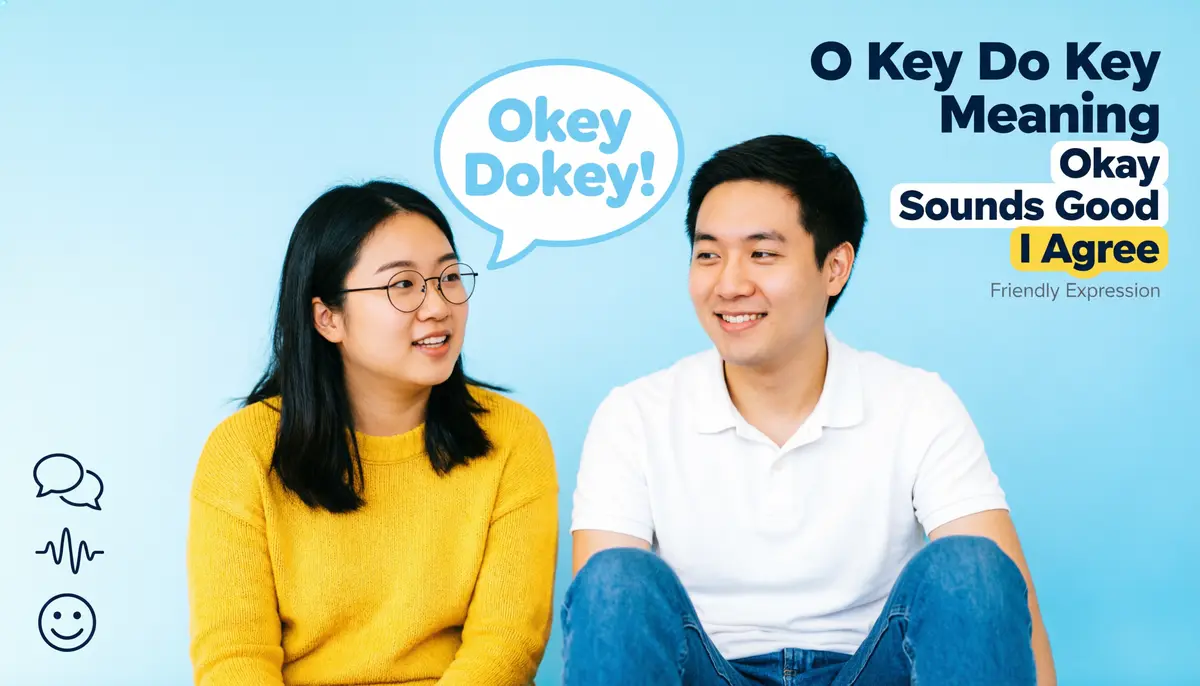
O key do key is a playful way of saying okay, all right, sounds good, I understand, or I agree. It is not the standard spelling you will find in formal writing. Instead, it is a phonetic version of the much more common expression okey dokey (also spelled okie dokie), which people use to make conversations sound warmer, friendlier, and more relaxed.
For example:
Friend: Can you send me the pictures tonight?
You: Okey dokey! I’ll send them after dinner.
Although o key do key appears in Google searches because people often spell it the way it sounds, okey dokey is the spelling most dictionaries and style guides recognize as the familiar informal expression.
What Does O Key Do Key Mean?
At its simplest, o key do key means exactly the same thing as okay. The difference is not in the meaning. It is in the feeling.
When someone says okay, they are simply agreeing or acknowledging something.
When they say okey dokey, they communicate the same message but with a lighter, friendlier, and slightly humorous tone.
Depending on the conversation, it can mean:
- Okay
- Sure
- Sounds good
- I understand
- I agree
- That is fine
- No problem
- I will do it
- Absolutely
- Got it
The phrase does not change the message. It changes the personality behind the message.
Simple Meaning Table
| Expression | Meaning | Tone | Common Situation |
|---|---|---|---|
| O key do key | Okay | Friendly | Casual conversations |
| Okey dokey | Okay | Playful | Friends and family |
| Okie dokie | Okay | Cheerful | Everyday speech |
| Okay | Agreement | Neutral | Any situation |
| OK | Agreement | Formal or brief | Emails, apps, business |
| All right | Acceptance | Neutral | Daily conversation |
Is O Key Do Key the Correct Spelling?
Not exactly.
One of the biggest reasons people search for o key do key is that they have heard someone say the phrase but have never seen it written.
English speakers usually learn this expression through conversation rather than books, so they naturally type it the way it sounds.
Here are the most common spellings you will see.
| Spelling | Common? | Notes |
|---|---|---|
| Okey dokey | ⭐⭐⭐⭐⭐ | Most widely recognized spelling |
| Okie dokie | ⭐⭐⭐⭐ | Very common, especially in American English |
| Okey doke | ⭐⭐⭐ | Shortened variation |
| Okie doke | ⭐⭐⭐ | Informal alternative |
| Okeydokey | ⭐⭐ | Closed form, less common |
| O key do key | ⭐⭐ | Phonetic spelling often searched online |
If you are writing an article, blog post, dialogue, or educational content, okey dokey is generally the safest spelling.
Why Do People Search for O Key Do Key?
This is one of the most interesting things about the phrase.
Millions of people hear expressions before they ever read them.
Imagine someone says:
Okey dokey!
If you have never seen it written, your brain naturally breaks it into separate words:
O key do key
Google receives thousands of searches like this because users spell phrases based on pronunciation instead of dictionary spelling.
Other examples include:
- alright → all right
- gonna → going to
- kinda → kind of
- lemme → let me
So, if you searched o key do key meaning, you are definitely not alone.
How Do You Pronounce O Key Do Key?
Native English speakers usually pronounce it like this:
oh-kee DOH-kee
IPA Pronunciation
/ˌoʊ.ki ˈdoʊ.ki/
Notice that the second word receives the strongest stress.
The phrase has a catchy rhythm, which explains why it has remained popular for decades.
What Does It Actually Express?
Even though the literal meaning is simply okay, the phrase often communicates additional emotions.
Someone saying okey dokey usually sounds:
- Cheerful
- Positive
- Cooperative
- Approachable
- Relaxed
- Playful
Compare these responses.
Person A: Can you help me tomorrow?
Reply 1
Okay.
Reply 2
Okey dokey!
Both mean yes.
The second one simply feels warmer.
That is why parents, teachers, close friends, and family members often use it.
Is O Key Do Key a Real English Word?
This question surprises many learners.
The answer is yes and no.
The expression itself is absolutely real.
English speakers have been saying it for nearly a century.
However, the exact spelling o key do key is not considered the standard written form.
Instead, dictionaries usually list:
- okey-dokey
- okey dokey
- okie-dokie
- okie dokie
These are recognized as informal expressions meaning okay.
OK vs. Okay vs. Okey vs. Okey Dokey
Many English learners wonder whether these expressions mean different things.
In reality, their meanings are almost identical.
The biggest difference is formality and tone.
| Expression | Meaning | Formal? | Best Used For |
|---|---|---|---|
| OK | Agreement | Yes | Business, labels, buttons |
| Okay | Agreement | Yes | Everyday writing |
| Okey | Nonstandard spelling | No | Rare, playful writing |
| Okey dokey | Friendly agreement | No | Casual conversation |
| Okie dokie | Friendly agreement | No | Family and friends |
Think of it like this:
- OK is short.
- Okay is standard.
- Okey dokey is expressive.
Is Okey Dokey Standard English?
Not exactly.
Language experts generally classify it as an informal expression rather than standard written English.
That means it is perfectly acceptable in:
- Conversations
- Text messages
- Family discussions
- Friendly emails
- Online chats
- Social media
- Storytelling
- Dialogue
But it is usually avoided in:
- Academic essays
- Research papers
- Legal writing
- Contracts
- Professional reports
- Business proposals
If your audience includes a teacher, employer, professor, or client, okay or OK is the safer choice.
The Fascinating Origin of O Key Do Key
The history actually begins with one of the world’s most famous words:
OK.
Although almost everyone knows it today, OK first appeared in the United States during the late 1830s.
It started as a humorous abbreviation for oll korrect, an intentionally misspelled version of all correct.
Newspapers loved playful abbreviations at the time.
Soon, OK spread throughout America.
Within a few decades, it had become one of the most recognizable words in the English language.
As people became more comfortable saying OK, they naturally invented fun variations.
One of those was:
Okey dokey.
Instead of changing the meaning, speakers simply added a rhyming ending to make the expression sound more cheerful.
Why Does Dokey Exist?
Interestingly, dokey does not have a dictionary meaning by itself.
It is simply there because English speakers enjoy rhyming words.
Linguists call this pattern rhyming reduplication.
This happens when people create memorable phrases by repeating similar sounds.
Other famous examples include:
- super-duper
- easy-peasy
- nitty-gritty
- hocus-pocus
- teeny-weeny
- hanky-panky
- wishy-washy
Okey dokey follows exactly the same language pattern.
The rhyme makes the phrase easier to remember and much more fun to say.
A Brief History of Okey Dokey
Although OK dates back to the 1830s, okey dokey appeared much later.
The earliest recorded examples appeared in the early twentieth century, and by 1931 the phrase was already showing up in newspapers and popular writing as a humorous alternative to OK.
Its popularity continued to grow through radio, television, cartoons, sitcoms, and family entertainment.
Timeline
| Year | Event |
|---|---|
| 1830s | OK first appears in American English. |
| Late 1800s | OK spreads internationally. |
| Early 1900s | Rhyming versions begin appearing. |
| 1931 | Okey dokey appears in print. |
| 1950s to 1970s | Frequently heard on radio and television. |
| 1980s to 1990s | Popular in sitcoms and cartoons. |
| 2000s | Common in texting and online messaging. |
| Today | Still widely recognized around the world. |
Unlike many slang terms that disappear after a few years, okey dokey has survived for generations because it is not tied to a single trend. Instead, it fills a timeless role as a cheerful way to say okay.
Grammar: Is O Key Do Key Grammatically Correct?
Yes, but only in the right context.
One of the biggest misconceptions is that o key do key is incorrect English. In reality, the phrase is grammatically acceptable as an informal interjection. The issue is not grammar. It is register, or how formal or informal your language is.
Think of it this way.
Okay is the standard choice for nearly every situation.
Okey dokey means the same thing but intentionally sounds playful.
O key do key is simply a phonetic spelling that people search for online.
If you are chatting with friends, saying Okey dokey! sounds perfectly natural. If you are writing a report for your manager or submitting a university assignment, Okay or a more specific response is the better option.
Parts of Speech: How Does Okay Work?
The word okay can perform several different grammatical roles. Playful versions like okey dokey are mainly used as interjections.
1. Interjection
An interjection expresses a quick reaction or response.
Examples:
✔ Okey dokey! I’ll be there at six.
✔ Okay! Let’s get started.
✔ OK, I understand.
This is how most people use the phrase.
2. Adjective
As an adjective, okay describes something as acceptable or satisfactory.
Examples:
The presentation was okay.
Everything looks okay now.
The food was okay, but nothing special.
Avoid writing:
✘ The presentation was okey dokey.
Although people may jokingly say this in conversation, it sounds awkward in normal writing.
3. Adverb
Sometimes okay describes how something happened.
Examples:
She performed okay during the interview.
The software worked okay after the update.
He handled the situation okay.
Again, avoid replacing it with okey dokey in this role.
✘ He performed okey dokey.
✔ He performed okay.
Okey Dokey vs. Okey-Dokey vs. Okeydokey
Many English learners wonder whether the phrase should contain a space, a hyphen, or no space at all.
The answer is simple.
All three forms exist, but they are not equally common.
| Spelling | Correct? | Formal? | Notes |
|---|---|---|---|
| Okey dokey | Yes | Informal | Most common written form |
| Okey-dokey | Yes | Informal | Common in dialogue and dictionaries |
| Okie dokie | Yes | Informal | Popular American spelling |
| Okie-dokie | Yes | Informal | Another accepted variation |
| Okeydokey | Yes | Informal | Less common closed form |
| O key do key | Search spelling | Informal | Usually typed by people who heard it first |
If you are writing an article, okey dokey or okey-dokey is the safest choice.
Why Do So Many Spellings Exist?
Unlike formal vocabulary, conversational expressions often evolve naturally.
People do not usually learn okey dokey from grammar books. They hear parents, teachers, TV characters, or friends say it first.
As a result, writers create spellings that match the sound.
That is why Google receives searches like:
- o key do key
- okie dokie
- okey dokey
- okey doke
- okie doke
- okay dokey
- okay dokie
- oky doky
They all point to the same cheerful expression.
Formal vs. Informal Usage
Understanding when to use the phrase is more important than understanding what it means.
Great Situations
Use okey dokey when talking with:
- Friends
- Family
- Classmates
- Children
- Neighbors
- Gaming teammates
- Group chats
- Social media followers
Examples:
Okey dokey! See you tonight.
Okey dokey, I’ll bring dessert.
Okey dokey! Sounds like a plan.
Situations to Avoid
Skip the phrase in:
- Job applications
- Academic essays
- Business proposals
- Legal contracts
- Professional presentations
- Government documents
- Formal reports
Instead, choose words like:
- Certainly
- Understood
- Confirmed
- Absolutely
- I’ll take care of it.
- That works for me.
Workplace Examples
Casual Team Chat
Manager:
Can you update the spreadsheet before lunch?
Employee:
Okay, I’ll finish it this morning.
Better Than Using Okey Dokey
Professional:
✔ Understood. I’ll send the revised file shortly.
Instead of:
✘ Okey dokey! I’ll do it.
While the second sentence is not rude, it sounds too casual for many workplaces.
School Examples
Teacher:
Please submit your assignment by Friday.
Student:
✔ Okay, I’ll upload it tonight.
Instead of:
✘ Okey dokey!
Teachers may not mind the phrase in conversation, but formal assignments should use standard English.
Text Message Examples
Casual conversations are different.
Friend:
Movie at 8?
You:
✔ Okey dokey!
Friend:
Do not forget the tickets.
You:
✔ Okey dokey 😊
The playful wording makes replies feel friendlier than a simple OK.
Social Media Examples
You will often see phrases like:
- Okey dokey, let’s do this!
- Okie dokie 😂
- Okey dokey, challenge accepted.
- It’s official. Okey dokey then!
Because social media favors relaxed communication, the phrase fits naturally.
Gaming Examples
Online games are full of quick confirmations.
Player 1:
Cover the left side.
Player 2:
Okey dokey!
Leader:
Everyone ready?
Team:
Okey dokey!
Its cheerful tone helps keep communication positive without slowing the game.
Everyday Conversation Examples
Between Friends
Ava:
Can you pick me up after work?
Lucas:
Okey dokey! I’ll be there around six.
At Home
Dad:
Please feed the dog before dinner.
Emily:
Okey dokey!
Phone Call
Caller:
I’ll email the details this afternoon.
You:
Okey dokey. Thanks!
Coffee Shop
Friend:
Meet here again tomorrow?
You:
Okey dokey!
Wrong vs. Right Examples
Here are some common corrections that English learners should know.
| Wrong | Better |
|---|---|
| Okey, I’ll send the report. | Okay, I’ll send the report. |
| Okey dokey, professor. | Okay, professor. |
| The presentation was okey dokey. | The presentation was okay. |
| She performed okey dokey. | She performed okay. |
| Okey dokey in my research paper… | Okay in formal writing… |
| Okey dokey, Your Honor. | Certainly, Your Honor. |
Common Mistakes
1. Thinking O Key Do Key Is Standard English
It is not.
The expression is real, but it is intentionally informal.
2. Using It in Professional Emails
Avoid writing:
Okey dokey, I’ll send the contract.
Write instead:
Certainly. I’ll send the contract this afternoon.
3. Believing It Has a Different Meaning Than Okay
It does not.
Only the tone changes.
4. Using It During Serious Conversations
Imagine responding during a court hearing:
Okey dokey.
Technically understandable.
Practically inappropriate.
Always match your words to the situation.
Better Alternatives
Sometimes replacing okay altogether makes your writing stronger.
| Instead of | Try |
|---|---|
| Okay | I agree. |
| Okay | Understood. |
| Okay | Confirmed. |
| Okay | Certainly. |
| Okay | I’ll handle it. |
| Okay | Sounds good. |
| Okay | Absolutely. |
| Okay | That works for me. |
| Okay | No problem. |
These alternatives communicate more precisely and often sound more professional.
Quick Proofreading Checklist
Before you use okey dokey, ask yourself:
- Is my audience a friend or a professional?
- Am I writing or speaking?
- Would okay sound more appropriate?
- Would a stronger phrase like confirmed or understood be clearer?
- Does the playful tone match the situation?
If the answer is no, replace it with a more neutral expression.
Easy Memory Trick
Remember this simple rule:
OKAY is Always Okay.
If you notice extra letters like dokey, dokie, or unusual spacing such as o key do key, you are looking at a playful variation rather than the standard form.
O Key Do Key vs. Okie Dokie vs. Okey Doke
Many people assume these phrases have different meanings, but they do not. The differences are almost entirely about spelling, style, and regional preference, not meaning.
All of these expressions communicate agreement, understanding, or acceptance in a cheerful, informal way.
| Expression | Meaning | Popularity | Best Used In |
|---|---|---|---|
| Okey dokey | Okay | ⭐⭐⭐⭐⭐ | General casual conversations |
| Okie dokie | Okay | ⭐⭐⭐⭐ | American English |
| Okey doke | Okay | ⭐⭐⭐ | Informal speech |
| Okie doke | Okay | ⭐⭐⭐ | Friendly chats |
| O key do key | Same meaning | ⭐⭐ | Search spelling rather than standard writing |
No matter which variation you hear, the intended message is usually the same: okay, sure, sounds good, or I understand.
Is O Key Do Key Slang?
Not exactly.
Although many people associate it with internet slang because they see it in text messages and social media posts, okey dokey existed long before the internet.
A more accurate description would be:
- Informal expression
- Conversational phrase
- Friendly interjection
- Playful variation of okay
Unlike modern slang that changes every few years, okey dokey has remained recognizable for nearly a century.
Is O Key Do Key an Idiom?
No.
An idiom has a meaning that cannot be understood from the individual words.
For example:
- Break the ice
- Hit the sack
- Spill the beans
These expressions do not mean exactly what the words suggest.
Okey dokey is different.
Its meaning is clear. It simply expresses agreement or acknowledgment in a playful way.
Because of that, it is better described as an informal conversational expression than an idiom.
Why Does O Key Do Key Sound So Friendly?
Language is about more than sharing information. It is also about expressing personality and emotion.
Compare these responses.
Response 1
Okay.
Response 2
Okey dokey!
Both communicate agreement, but the second one sounds:
- Warmer
- More enthusiastic
- More approachable
- More conversational
- Slightly humorous
That cheerful rhythm is one reason parents, teachers, and close friends often use it.
Regional Usage Around the World
Although the phrase began in American English, it has spread to many English-speaking countries.
United States
Americans use okey dokey and okie dokie frequently in relaxed conversations. It is especially common among families, teachers, and older generations, though younger speakers still recognize it.
United Kingdom
British English speakers understand the phrase, but they may be more likely to say:
- All right
- Right then
- Okay then
Even so, okey dokey is widely recognized.
Canada
Canadian English uses the expression much like American English. It appears naturally in casual conversations, text messages, and family .
Australia
Australians understand okey dokey, but local expressions such as no worries or too easy are often more common.
New Zealand
The phrase is familiar and understood, although speakers may prefer local conversational alternatives in everyday speech.
No matter where you travel in the English-speaking world, most people will understand what okey dokey means.
O Key Do Key in Modern Communication
Despite being almost 100 years old, the phrase continues to appear in everyday communication.
You will still hear or read it in:
- Text messages
- WhatsApp chats
- Facebook comments
- Instagram captions
- Reddit discussions
- Discord servers
- Gaming communities
- Podcasts
- Family conversations
- Classroom discussions
Many people choose okey dokey because it feels friendlier than simply typing OK.
Compare these replies.
Reply A
OK.
Reply B
Okey dokey! 😊
The second response feels warmer and more personal, even though both mean the same thing.
Similar Expressions You Can Use
If you do not want to repeat okey dokey, there are plenty of alternatives that fit different situations.
| Expression | Meaning | Tone | Best Used In |
|---|---|---|---|
| Okay | Agreement | Neutral | Any situation |
| OK | Confirmation | Neutral | Business, apps, messages |
| All right | Acceptance | Neutral | Everyday conversations |
| Sure | Willing agreement | Friendly | Casual speech |
| Sounds good | Positive agreement | Relaxed | Making plans |
| No problem | Happy to help | Friendly | Informal |
| Got it | I understand | Neutral | Instructions |
| Absolutely | Strong agreement | Positive | Casual and professional |
| Certainly | Professional agreement | Formal communication | |
| Of course | Polite agreement | Neutral | Daily conversations |
| That works for me | Acceptance | Friendly | Planning |
| I’ll take care of it | Confirmation | Professional | Workplace |
Choosing the right alternative depends on your audience and the tone you want to create.
Frequently Asked Questions
What does o key do key mean?
It means okay, all right, I understand, I agree, or sounds good. It is a playful and informal way of responding positively.
Is o key do key the same as okey dokey?
Yes. O key do key is simply a phonetic spelling that reflects how the phrase sounds when spoken. Okey dokey is the more common written form.
Which spelling is considered standard?
For informal writing, okey dokey and okie dokie are the most widely recognized spellings. In formal writing, use okay or OK.
Is o key do key grammatically correct?
As an informal conversational response, yes. However, it is not appropriate for most formal documents or professional communication.
Can I use okey dokey in a business email?
It is better not to. Choose Okay, Understood, Confirmed, or Certainly instead.
Is okey dokey old-fashioned?
Some people associate it with an older generation, but it remains widely understood and is still used in everyday conversations, especially with family and friends.
Is it American English?
The phrase originated in American English but is now recognized across many English-speaking countries.
Why do parents often say okey dokey?
Its cheerful rhythm makes it encouraging and easy for children to understand, which is why many parents and teachers use it.
Can children use it?
Absolutely. It is a polite, family-friendly expression that children and adults can both use in casual conversations.
Does it have a negative meaning?
No. It is almost always used positively to express agreement, acceptance, or understanding.
Is it common in text messages?
Yes. Many people use okey dokey or okie dokie to make their replies sound warmer than a simple OK.
Can I use it every day?
Yes, as long as you are speaking in an informal setting with friends, family, classmates, or close coworkers
